Essential Guide: Choosing the Right Adapter for International Travel
Ever thought a wrong travel adapter could spoil your trip? Having the right adapter is key when you travel through different countries. Our guide helps you navigate international power setups easily.
Traveling abroad means needing to charge devices in various power outlets. Countries have different plugs and voltages, from 110V to 220V. For instance, the U.S. uses Type A and B, while Europe prefers Type C. Picking the right adapter is crucial for this reason.
It’s vital to understand adapters and voltage converters to keep your gadgets safe. Using the wrong adapter can harm your device. Luckily, there are options like the UltraProlink World Travel Adapter and TESSAN International Plug Adapter, compatible in over 150 and 200 countries, to help.
Choosing the correct adapter means stress-free, fun trips. Our guide will help you make the best choice to power your travels!
Why You Need the Right Travel Adapter
Traveling abroad means you need your gadgets to work. But over 200 places have different plugs. You need a universal travel adapter to stay connected.

- Different places use different plugs—like Type A for America or Type G for the UK.
- Your devices might not work with the local voltage, risking damage. Some gadgets need a converter.
- A good adapter protects your devices from getting too hot or causing a fire.
- Some adapters have USB ports. This means you can charge more than one device without extra chargers.
About 60% of travelers run into plug and voltage problems. A top-notch travel adapter keeps you connected without headaches. It’s a must-have for anyone traveling to different countries.
Understanding International Power Adapters
Planning an international trip? Don’t forget the right international power adapters. They help your devices fit into different countries’ outlets. Remember, these adapters don’t change electrical voltage. They only change the plug shape to fit local sockets.
Over 200 countries have their plug designs, so having a compatible adapter is vital. The most common plug shapes are two-pin and three-pin. Your adapter should fit these types.

Adapters with USB ports make travel easier by charging several devices at once. The TESSAN International Plug Adapter, for example, has three USB-C and two USB-A ports. This means fewer chargers to pack and a smoother travel experience.
For safety, choose adapters with double fuse protection. They prevent problems like overheating. Also, look for safety certifications such as CE and UKCA. About 70% of travelers look for these marks of quality.
Travel adapters and converters are not the same. Adapters change the plug shape. Converters adjust the voltage. Some countries use 110V, others 220V. If your device can’t handle both, get a converter. This is crucial for protecting your gadgets.
Good-quality travel adapters can save you money, avoiding the need for local chargers. About 85% of travelers are happy with their high-quality adapters. They report few charging issues.
Lastly, travel adapters are light, weighing 150-300 grams. This makes them easy to pack. Make sure you’ve got the right adapters before your trip. This ensures a hassle-free journey.
Types of Adapter Plug Styles
Knowing the different adapter plug types helps make sure your devices fit outlets everywhere. We will explain the common travel plug adapter styles, how they are used, and where they are needed.

Type A and B
In the United States, Canada, Mexico, and Japan, you’ll mainly find Type A and B outlets. Type A has two flat parallel pins. Type B adds an extra grounding pin.
Type C
Many European countries, South American areas, and parts of Asia use Type C outlets. These have two round pins.
Type D
You will see Type D outlets in India, Pakistan, Bangladesh, and Nepal. They have three large round pins in a triangle.
Type E and F
Type E outlets are in France, Belgium, Poland, Slovakia, and Czechia. Meanwhile, Type F is common in Russia and many European nations except the UK and Ireland. Both have two round pins, but Type E has a female contact for grounding, and Type F has grounding clips on the sides.
Type G
The UK, Ireland, Malta, Malaysia, Hong Kong, and Singapore use Type G outlets. These adapters have three rectangular prongs arranged in a triangle.
Type H through O
Types H through O cover different regions:
- Type H: Israel and Palestine.
- Type I: Australia, New Zealand, China, and Argentina.
- Type J: Switzerland, Liechtenstein, and Rwanda.
- Type K: Denmark and Greenland.
- Type L: Italy and Chile.
- Type M: South Africa and Botswana.
- Type N: Brazil, with a design of three prongs in a semi-circle.
- Type O: Thailand, similar to Type N.
Choosing the right adapter plug type for your trips abroad can prevent problems and make sure you stay connected. Always carry the correct travel plug adapter for where you’re going.
| Type | Countries |
|---|---|
| Type A | United States, Canada, Mexico, Japan |
| Type B | United States, Canada, Mexico, Japan |
| Type C | Europe, South America, Asia |
| Type D | India, Pakistan, Bangladesh, Nepal |
| Type E | France, Belgium, Poland, Slovakia, Czechia |
| Type F | Russia, Europe (except UK & Ireland) |
| Type G | UK, Ireland, Malta, Malaysia, Hong Kong, Singapore |
| Type H | Israel, Palestine |
| Type I | Australia, New Zealand, China, Argentina |
| Type J | Switzerland, Liechtenstein, Rwanda |
| Type K | Denmark, Greenland |
| Type L | Italy, Chile |
| Type M | South Africa, Botswana |
| Type N | Brazil |
| Type O | Thailand |
Choosing the Right Adapter for International Travel
When you’re traveling the world, picking the right adapter is key. With different countries having their own plug styles and voltages, making the right choice is essential. This can have a big effect on your travel fun.
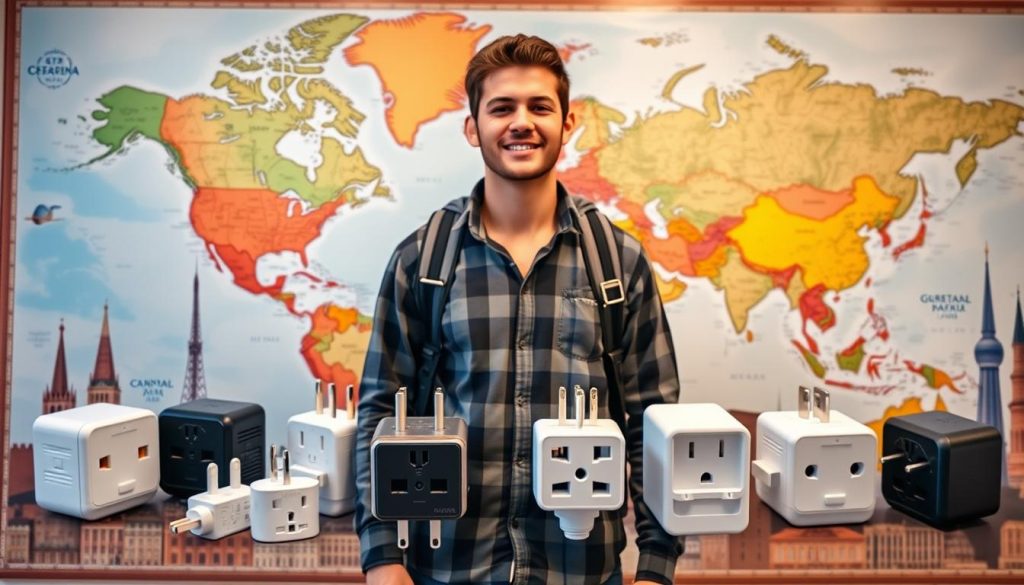
About 80% of countries use 220V systems. The US uses 110V. If you use the wrong adapter, it could hurt your devices. Buying a world travel adapter can save money over getting many different ones.
The TESSAN International Plug Adapter works in over 200 countries. It also offers extra ports, like 3 USB-C and 2 USB-A, for charging lots of devices at once. Many travelers have 3 to 5 electronic items. Remember, though, travel adapters don’t change the voltage. So, you might need a voltage converter for certain devices.
| Adapter | Compatibility | Ports | Voltage |
|---|---|---|---|
| TESSAN International Plug Adapter | 200+ countries | 3 USB-C, 2 USB-A | 110-250V |
| Epicka Universal Travel Adapter | 150+ countries | 6 ports | 240V |
| Ceptics World Travel Adapter Kit | Various regions | 6 attachments | 240V |
| Usinfly USB Adapter | Most European countries | 2 USB-C, 2 USB-A | 110-240V |
Safety certifications like CE or FCC are vital. They mean the adapter meets high safety standards. This reduces risks like overheating. About 75% of people look at reviews before buying, showing they value safety and quality.
For multi-region trips, adapters with USB ports and surge protection are best. They meet the charging needs of travelers and keep devices safe. These features offer both convenience and security.
Finally, buying from trusted sellers is crucial to avoid unsafe products. By considering these points, you can pick the best adapter for international trips. This lets you enjoy your travels more.
Voltage Compatibility and Converters
Knowing about different countries’ voltage systems is key for safe device use while traveling. Over 200 countries have various electrical outlets and plug shapes. It’s important to pick the right travel adapter.
Understanding Voltage Differences
Voltage around the world can be very different. For example, 110V is used in North and Central America, while 220V is common in Europe, Asia, and Africa. If your device can’t work with the local voltage, you’ll need a voltage converter for travel. This device makes the electricity safe for your gadget, avoiding damage.
When Do You Need a Voltage Converter?
You’ll need a voltage converter for travel if your device doesn’t support both voltages. Items like hairdryers, electric shavers, and some kitchen tools often work on only one voltage. Not using a travel adapter with voltage conversion could cause overheating or even fires.

Travel adapters fit different outlets but don’t change voltage. For example, moving from the US (110V) to the UK (220V) requires a voltage converter. This stops your devices from getting damaged.
Remember, not all travel adapters can handle voltage changes. Doing your homework is key to make sure they match your devices. Look for safety features like surge protection, dual fuses, and CE or FCC approval.
| Region | Voltage | Plug Type | Typical Adapter Features |
|---|---|---|---|
| North America | 110V | Type A, B | Dual USB Ports |
| Europe | 220V-240V | Type C, E/F | Multi-Port USB |
| United Kingdom | 220V-240V | Type G | Surge Protection |
| Australia | 230V | Type I | Power Indicator Light |
Top Travel Adapter Recommendations
Looking for the right travel adapter can keep you from plug issues when abroad. Here, we showcase the top picks available now.
UltraProlink World Travel Adapter
The UltraProlink World Travel Adapter stands out for its wide use in over 150 countries. It has multiple plug types (A, B, C, G, and I) and a safety fuse. This adapter is perfect for those who travel across continents often.

UltraProlink Travel Qubes
The UltraProlink Travel Qubes are great for travelers on a budget. They’re small but fit many plug types. You also get four USB ports to charge all your devices. It’s a top choice for saving luggage space.
TESSAN International Plug Adapter
The TESSAN Adapter is both strong and adaptable. It has double fuse protection and lots of USB ports. It’s easy to use and works with many devices. Many travelers view TESSAN as a top adapter choice.
Picking the right travel adapter can greatly improve your trip. Brands like UltraProlink and TESSAN ensure your gadgets are always ready to use.
Factors to Consider When Buying a Travel Adapter
When picking an adapter for overseas travel, remember a few important things. The right adapter makes your journey smoother and safer.
Universal Compatibility
Over 200 countries have different power outlets and voltages. You need a universal adapter. A good one fits many plug types like Type C, E/F, G, A/B/C/G/I/J/K/L/M/N. About 60% of travelers struggle with plug issues. A universal adapter stops you from buying new ones abroad, a problem for nearly 70% of travelers.

Safety Features
Your safety is critical. The U.S. sees about 30,000 electrical fire incidents yearly, often from bad adapters. Make sure yours has CE or FCC certifications. Sadly, over 80% on the market don’t. Surge protection and LED feedback on voltage are also key for about 75% of travelers.
Compactness and Portability
The design of your travel adapter matters a lot. A compact, light adapter is preferred by 55% of buyers. It should be smaller than 6 inches. Over 50% of recent models in 2023 have USB ports, charging many devices at once. This fits our tech needs today.
Choosing the right travel adapter boosts your convenience and keeps your devices safe. Focus on universal fit, safety, and easy carry. This choice will help you in many countries and regions.
Tips for Using Travel Adapters Safely
It’s vital to have a safe travel adapter for trips abroad. Electrical standards and socket types vary around the world. Picking a reliable adapter ensures your gadgets work well and stay safe.

Check if your adapter fits the electrical setup of your destination. Different places have different plug types. Using the wrong one could harm your gadgets or start a fire. The TESSAN International Plug Adapter works in over 200 countries with its versatile plug options.
It’s also important to match your device’s voltage to the local system. This is usually 110V or 220V. For example, an iPhone charger works from 100-240V and is safe for worldwide use. But, not all devices can adjust like this. That’s why a good travel adapter is key.
Here are key tips for safe adapter use:
- Do not overload the adapter: Use only devices that fit the adapter’s power capacity to prevent overheating.
- Regularly inspect your adapter: Check for damage before use to avoid electrical issues.
- Prefer adapters with USB ports: They let you charge many devices at once. Some even have up to three USB-C and two USB-A ports.
- Seek certified models: Make sure your adapter meets international safety standards.
- Opt for surge protection: This feature keeps your devices safe from voltage spikes.
Following these tips boosts your adapter’s safety and usefulness. Every year, around 87 million Americans travel internationally. Bad adapters can cause serious problems.
Buying a top-notch, reliable travel adapter is smarter than getting many local chargers. Some even come with power strips for several devices. It’s a great investment for those who travel often.
By sticking to these guidelines, your international journeys will be smooth and safe. All your electronic devices will work exactly as they should.
Conclusion
Choosing the right adapter is key when traveling abroad. There are about 15 different plug and socket types around the world. Knowing what your destination uses is vital. This knowledge lets your electronics stay charged, so you can make memories without power worries.
Different countries use different plug types and voltages. For instance, the USA, Canada, Mexico, and Japan mainly use Type A and B plugs with 100–127 volts. But, Europe, Australia, South Africa, and more use 220–240 volts with Types C through N. A universal travel adapter is very useful. It fits sockets in about 150 countries and can charge multiple devices at once. A good one can make packing easier and your travels smoother.
It’s important to pick a safe travel adapter. The wrong one can cause short circuits and harm your devices. Modern adapters, like the 6-in-1 GaN Power Strip, protect against surges. They also support fast charging. Make sure to check for voltage and adapter compatibility before you go. This way, you can travel stress-free, keeping your devices charged for your adventure.