Smart Budgeting Tips for Frequent Business Travelers
Have you thought about how much you could save by planning your business trips well? Planning every part of your trip carefully can really cut costs.
Many professionals travel for work, and the expenses can add up if not watched closely. Learning to budget well can save a lot of money, especially for those who travel a lot. Did you know that 22% of business travelers spend too much because they book their trips at the last minute? Smart budgeting means booking early, using tech smartly, and choosing cheaper options when you travel.
For example, A-Gas saved 10% each year just by booking flights 15 days earlier than usual. Small changes like this can greatly reduce your travel costs. Flying out in the middle of the week could save you $35. Also, hotel stays on Thursdays could be $60 less than on weekends.
It’s also wise to use tools like Ramp with Melon to keep an eye on spending and avoid going over budget. Booking flights three weeks early helps lock in good prices and avoid sudden increases that can be over 50%. Plus, avoiding Mondays and Fridays for money exchanges can keep costs down, thanks to steadier rates mid-week.
Following these tips can help you get better at planning your travel budget. This way, you can meet your business goals without overspending.
Choosing Budget-Friendly Destinations for Your Business Trips
When planning your next business trip, picking the right place matters a lot for your costs. Going for cheaper travel spots helps you save money. Here are key tips to remember:
First, look at cities where living is cheaper. Studies show some places cost up to 40% less than big business cities. These areas have cheaper hotels and lower costs for things like food and getting around.
To find the best spot, use smart budget tips. Check the local money value, rules for businesses, and how seasons change prices. Prices can drop a lot if you travel when it’s not busy.
Also, pick places with good deals for business folks. Many cities have lower prices for people going to conferences or traveling for work. Use these deals to spend less on staying and events.
Don’t forget about loyalty programs. They let you earn points that save you money later. Always join hotel and flight programs. You could cut costs by up to 40%, making trips cheaper but still comfy.
Using these ideas will help you pick cheap places for work trips. This saves your company money and makes your travels better. Smart planning and looking into things can make business travel both cheap and fulfilling.
Booking Flights Smartly to Cut Costs
When you book flights, using smart methods can lower your travel costs a lot. By applying money-saving strategies for business travelers, you can use your budget better. This can lead to big savings.
Using Flight Comparison Tools
Using flight comparison tools is a great way to save money on business travel. These websites collect info from many airlines. So, you can quickly find the cheapest flights. Recent stats show 67% of frequent flyers use these sites to find better prices, saving a lot of money.
Here’s some info to remember when using comparison tools:
| Booking Advance | Potential Savings |
|---|---|
| 21 Days or More | Up to 30% |
| 7-20 Days | 15-20% |
| Less than 7 Days | Minimal |
Booking your flights at least 21 days early can cut costs by 30%. This proves that planning ahead is key to managing travel expenses efficiently.
Traveling During Off-Peak Hours
Avoiding busy travel times is another key money-saving strategy for business travelers. Prices go up in the morning because that’s when business folks usually fly. Flying in the afternoon or during the week can save you money.
Being flexible with your travel dates can change prices by up to 40%. The Global Business Travel Association says traveling in off-peak times can also save on hotels and other costs.
In conclusion, using flight comparison sites and flying during less busy times helps lower business travel costs. By using these ways to save money on business travel, you can spend your budget more on other business areas.
Opting for Economical Accommodations
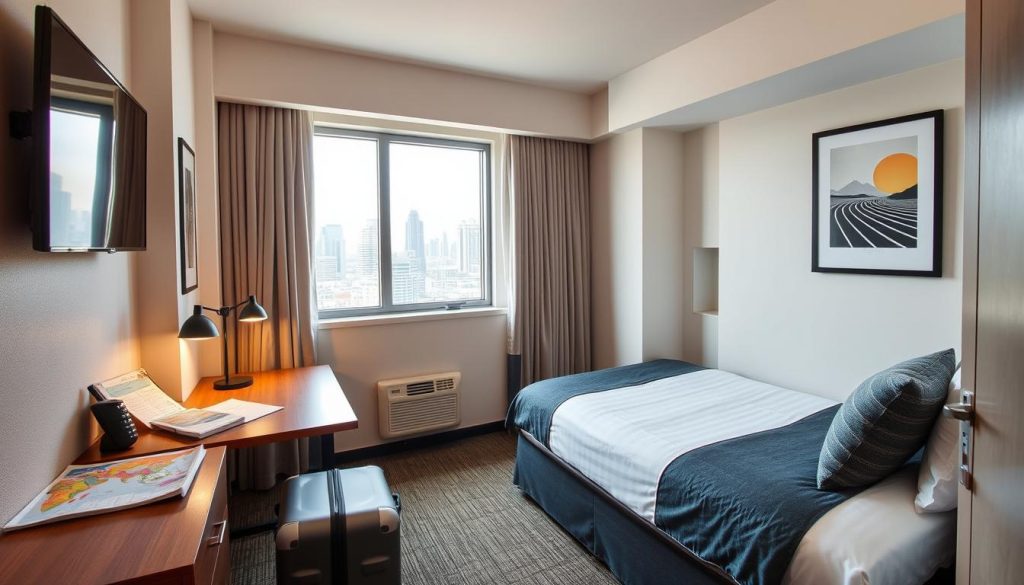
Finding affordable places to stay can really help your business travel budget. Lodging makes up 34% of the average budget for business trips. By choosing less expensive places to stay, you save money. This lets you spend on more important parts of your trip.
Exploring Budget Hotels and Rentals
Looking into budget hotels and vacation rentals is a smart move. Websites like Airbnb offer a range of choices. These include entire apartments to rooms you share with others. Hotels like Motel 6 and Red Roof Inn are also good for staying within your budget.
Talking directly to where you’re staying can also save you money. Ask for discounts, especially if you’re staying longer. Many places offer lower prices for longer stays.
Sharing Accommodations with Colleagues
Shared lodging cost management is another good idea. Staying with colleagues can greatly reduce how much you spend on lodging. It’s a chance to save and build stronger team connections.
Think about getting a larger rental where your team can stay together. This divides the cost, making it cheaper for everyone. Plus, these places often have more to offer than hotel rooms, making the trip better.
| Accommodation Type | Average Cost per Night (USD) | Benefits |
|---|---|---|
| Budget Hotels | $50-$100 | Cost-effective, basic amenities |
| Vacation Rentals | $60-$150 | Home-like environment, potential for shared costs |
| Shared Lodging | $30-$80 | Lower individual costs, team building opportunities |
Managing your accommodation budget well means being strategic and flexible. By choosing budget-friendly options or staying with team members, you keep costs low. This lets you use your budget for other important parts of your business trip.
Packing Efficiently to Avoid Extra Charges
Packing smart is key for those who travel often for work. It helps to manage expenses well. By following smart packing tips, you can avoid extra costs. Plus, you’ll have everything you need within reach.
- First, try a capsule wardrobe. Mix and match a few pieces to cut your luggage in half. This is great for dodging extra baggage fees.
- Next, use compression bags. They can give you up to 50% more space. This makes it easier to pack your carry-on, which is usually 15 to 25 pounds.
- Also, roll instead of fold your clothes. Rolling saves up to 30% more space than folding.
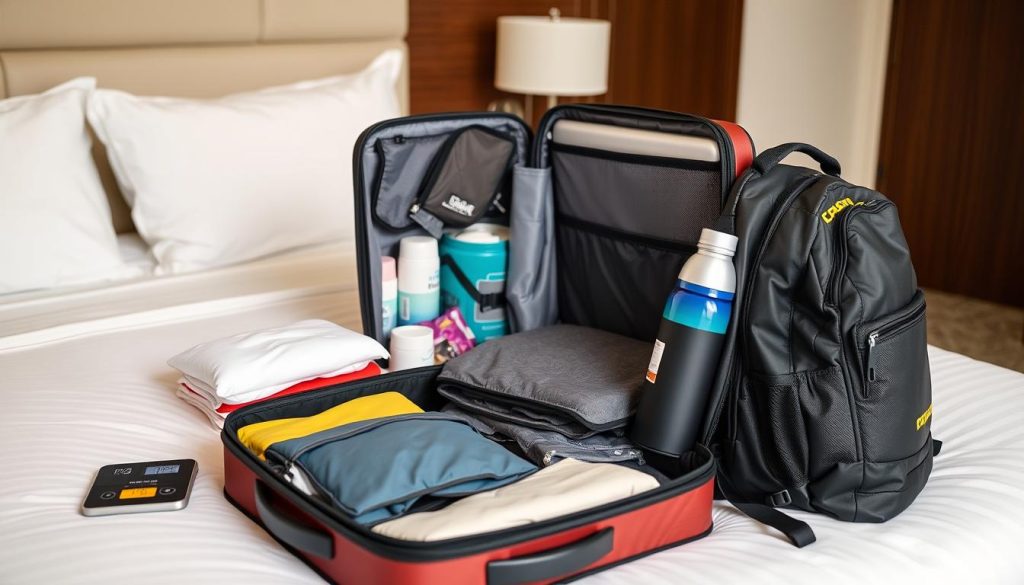
It’s best for business travelers to pack only the needed items. Keep to the carry-on size of 22 x 14 x 9 inches. And the typical checked baggage limit is about 50 pounds. This helps to avoid extra luggage fees. Roughly 35% of travelers go over their luggage limit each year. This leads to extra costs that could be avoided.
Here are some more tips to manage expenses on business trips through smart packing:
- Stick to travel-sized essentials: Use small toiletries to save space. This also meets airport security rules.
- Pack for the trip length: The rule is to pack for three days, then add one more outfit for longer stays.
- Avoid heavy fabrics: Choose fabrics that are light and won’t wrinkle. They take less space and don’t add weight.
Moreover, since 2020, overpacking dropped by 53%. Now, 35% of travelers see overpacking as the biggest error. Using these smart packing tips can help you manage expenses well. Plus, your packing will be easier and stress-free.
Utilizing Technology for Expense Management
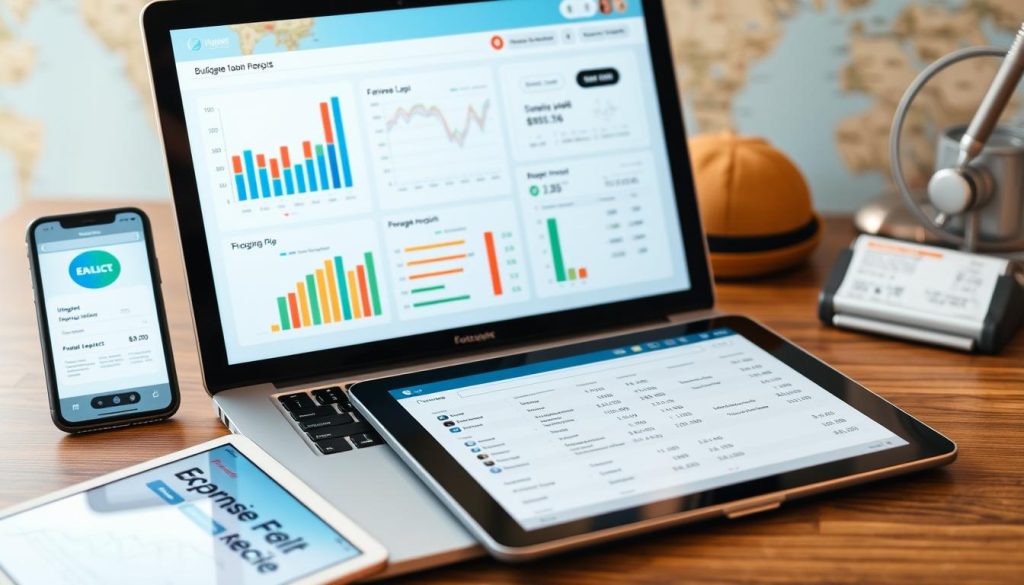
Digital tools for tracking expenses are key for businesses to handle their travel costs well. By integrating technology in travel planning, companies can make everything from bookings to reimbursements run smoother and cost less.
Expense-Tracking Apps
Apps like Expensify and Concur have changed how business travelers handle their expenses. These apps make it easy to submit receipts, categorize spending, and automate approvals. With expense-tracking apps, employees can quickly take photos of receipts. This makes sure no expense is missed since companies need receipts for reimbursements.
Mobile apps are now used for over half of all expense reports, showing they are popular and useful. A Certify survey predicts that by 2025, 75% of businesses will mainly use mobile apps for expense tracking and reporting. The move to digital receipts and e-invoicing, which 90% of businesses will adopt by 2025, cuts down paper use. It also makes access easier and helps follow company rules better.
All-in-One Travel Platforms
SAP Concur and TripActions offer all-in-one solutions that combine booking, expense tracking, and reimbursement. These platforms help manage travel costs by connecting all parts of travel planning and expense management in one spot.
These platforms not only offer easy handling of expenses. They also let businesses automate expense tracking and reporting, which means work is done more efficiently and with fewer mistakes. Automated processes save time for travelers and finance teams. By 2025, 80% of companies will use expense analytics tools. These tools provide detailed information on spending habits and where to save money.
Using integrating technology in travel planning improves the management of travel expenses. Digital platforms enforce travel policies, which helps avoid overspending and control costs. Reward programs encourage travelers to spend wisely, making spending more efficient.
| Software/Feature | Functionality | Benefits |
|---|---|---|
| Expensify | Receipt scanning and automated expense tracking | Reduces manual input, ensures accurate expense submissions |
| Concur | Expense report automation and approval workflows | Increases efficiency, minimizes compliance risks |
| SAP Concur | All-in-one travel and expense management | Streamlines processes, provides analytical insights |
| TripActions | Comprehensive travel booking and expense tracking | Enhances user experience, improves cost control |
Budgeting Tips for Frequent Business Travelers
As a frequent business traveler, learning how to budget wisely is key. It’s about knowing your company’s travel rules and how you spend money. Here’s how to keep your costs in check and still enjoy your travels:
First, understand what you usually spend on trips. The typical cost is about $800 per day per person. Most of this goes to flights—34%, then hotels—28%, meals—19%, ground transport—18%, and other stuff—1%. Smart planning helps frequent travelers save money.
Booking your flight early can cut costs by over 50%. Waiting until the last minute can cost you 56% more. For hotels, booking two weeks in advance is 13% cheaper than four months early. Planning ahead is crucial for saving on travel.
Choosing places like Airbnb for longer stays can save cash. About 70% of travelers like these options for their good prices. Sometimes, vacation rentals turn out pricier than hotels. So, see what’s best for you.
For getting around, consider public transport or rideshares. They can be 25% cheaper than taxis. Business travelers are finding smart ways to cut travel costs.
Using reward programs can also reduce expenses. Roughly 45% of travelers use apps to track spending. They save an average of 20% through points and miles for flights and hotels.
Many businesses give a daily food budget of $50 to $75. This helps manage meal costs. After trips, 65% of travelers review their spending to find ways to save next time.
With these tips for financial planning for business travel, you can stretch your budget further. You’ll enjoy your business trips more, all while sticking to your company’s spending rules.
Leveraging Rewards and Loyalty Programs
You can gain a lot from your business travel by maximizing loyalty benefits and joining reward programs wisely. A whopping 70% of frequent flyers are into reward schemes, showing their value. And about 90% of frequent travelers are in at least one airline loyalty program, making these plans a key part of travel today.
Frequent Flyer Miles
Frequent flyer programs are a big hit, guiding 70% of travelers in choosing airlines. Through alliances like Star Alliance, oneworld, or SkyTeam, you can earn points on several airlines. About 62% of travelers pick an airline for its loyalty rewards, and smart ones could save up to 30% on flights by collecting points wisely.
To get the most out of loyalty programs, keep up with sign-up bonuses, promotions, and high-return travel reward credit cards. Make sure to check your memberships so you don’t lose points and combine different programs and payment methods to stack rewards.
Hotel Loyalty Programs
Hotels, just like airlines, have loyalty programs that offer room upgrades, free nights, and more. Around 40% of business travelers look for these benefits when picking hotels, seeing the big advantages. Planning events at these hotels can also bring rewards to the planners.
Joining several hotel loyalty programs early on can really boost the rewards you get. Travel reward credit cards are helpful, but check the fees against the benefits. Smaller businesses or self-employed people can use corporate cards to get rewards on all business spending, not just on travel.
Below is a comparative table highlighting key benefits of popular loyalty programs:
| Program | Alliance | Key Benefits |
|---|---|---|
| Delta SkyMiles | SkyTeam | Miles never expire, free upgrades, priority boarding |
| Marriott Bonvoy | N/A | Free night awards, room upgrades, late checkout |
| United MileagePlus | Star Alliance | Free flights, access to partner lounges, companion certificates |
| Hilton Honors | N/A | Free nights, room upgrades, double points on stays |
In the end, smartly engaging in rewards programs and maximizing loyalty benefits can save you money and make your trips better. By picking the right programs and staying updated, each trip can bring more value to your future adventures.
Managing Transportation Costs on Business Trips
It’s important to budget well for business travel to keep a company’s finances healthy. Cutting down on transport costs helps lower the overall expense of trips. By choosing cost-effective travel options and planning carefully, businesses can avoid spending too much and use their money better.
Using Public Transportation
Using public transport is a smart way to cut transportation costs. Many cities have good transit systems that are reliable and cheap. Buses, subways, and trains let employees save a lot, unlike using taxis or renting cars.
- Public transit covers lots of areas, which is great for getting to different meeting spots.
- Knowing public transport costs helps with budgeting since their prices don’t change much.
Car Rentals and Ride-Sharing
If public transport isn’t an option, car rentals and ride-sharing can be affordable ways to travel. Sharing rental cars among employees cuts costs, especially for trips with many stops or longer journeys. Services like Uber and Lyft are cheap choices for short trips in the city.
- Sharing rental cars makes them more affordable and flexible.
- Ride-sharing can be booked ahead, making trip planning more efficient.
Keeping an eye on costs and exploring local transport options are key. This way, businesses can always find the cheapest way to travel on business trips.
Finding Budget-Friendly Dining Options
Finding affordable meals while traveling for business can be tough. But, there are ways to eat well without spending too much. Here are some tips to help you save on dining during your trips.

- Local Eateries: Choose local spots over high-end tourist restaurants. You can eat for 25% to 50% less.
- Street Food: Street food is usually more affordable and lets you taste the local flavor. It’s a smart way to save.
- Food Markets: Food markets provide fresh, inexpensive options. They are a budget-friendly way to enjoy tasty meals.
- Free Breakfasts: Some hotels offer free breakfast buffets. Eating here can save you 20-25% on daily meals.
- Accommodations with Kitchens: Staying in places with kitchens can save you around $20 to $30 per person each day. Cooking your meals cuts costs, especially on longer trips.
- Avoid Airport Meals: Airport food tends to be pricier. Skipping it can lead to noticeable savings.
Packing snacks can prevent spending on pricey last-minute meals. Daily deals on sites like Groupon could save you 40%-50% at restaurants. Yelp and Google Maps are great for finding affordable places to eat by filtering for price.
- Comparing M&IE Rates: Knowing the per-diem rates for meals and incidental expenses helps budgeting. In 2023, San Francisco offers $79, while Elko, Nevada, has a rate of $59.
- Sensitive Spending in Europe: Watch for extra charges in European eateries. Items like bread might cost you $1.50 to $4.50.
- Local Discounts: Sites like Restaurant.com and Groupon offer big dining discounts, though experiences can vary.
Using these tips can help you enjoy great meals without overspending. Careful planning and smart choices make saving on meals easy and fun.
Conclusion
Smart planning is key to cutting down on business travel costs. Companies use 6% to 8% of their budgets on travel. Choosing cheaper places and flying at less busy times helps save money.
It’s smart to manage your stay and travel cheaply. Use affordable hotels, share rides, and take public transport to cut costs. Apps and travel sites make it easier to keep track of expenses. They help stick to company budgets, saving up to 25%.
Signing up for rewards programs can also reduce travel expenses by up to 20%. Managing time well and staying healthy keeps you productive. This means less stress and fewer days off work. By using these tips, travelers can make their business trips more affordable. This way, they don’t have to give up quality for a lower price.