Need a Charger on the Go? Pack a Backup for Devices
Ever found yourself with a dead phone and nowhere to charge it? In our fast-moving world, having power on the go is crucial. From finding your way in a new place to keeping up with work or enjoying shows, a backup charger is key. So, why is a portable power bank a must-have for modern travelers?
Our devices are now vital in our daily lives. Missing an important call or a perfect photo because your phone died is frustrating. With a backup charger, you keep your smartphone, tablet, or other gadgets charged. This avoids the inconvenience of your device dying at the wrong time.
A good portable power bank can fully charge most phones several times. For instance, the Belkin Boost Charge Plus 10K has a big capacity of 10,000 mAh. It can keep your iPhone 14 or a similar device charged all day.
Ready to learn more about backup power options? Finding the right portable power bank is crucial in today’s busy world. Let’s see why having one is essential, not just a luxury.
Why You Need a Backup Charger for Your Devices
In this digital world, staying connected and productive is key. A backup charger is a must-have. It keeps your gadgets like smartphones, tablets, and laptops charged all day long.
Avoiding Disconnection
Current cell phones have batteries around 4,000 to 5,000mAh. A dead battery means you could miss calls, emails, and be offline. With a backup charger, you’re always prepared, ensuring you stay connected during crucial moments. Whether it’s an important meeting or using your phone for maps, a backup charger means you’re always ready.
Ensuring Productivity
Don’t let a dying battery slow you down. For example, a 20,000mAh power bank can recharge an iPhone 11 around six times, considering efficiency losses. We use our devices for work, fun, and everything in between. It’s vital they keep working.
Now, many people own multiple power banks. This is because they’re afraid of running out of charge and the chargers are easy to buy. They’re found in stores like Walmart, Target, and Best Buy. They’re also online at places like Amazon. High-capacity chargers mean your devices always work, boosting your productivity and giving you peace of mind.
Understanding Different Types of Backup Chargers
Knowing the right backup charger for your devices is key. There are several types, each with unique features for different needs. This helps to choose what’s best for you.

Portable Power Banks
A portable power bank is widely used and very flexible. They range from 2,000 mAh to 48,000 mAh. This means they fit easliy into your pocket or bag.
Models with more power can charge smartphones many times. So, you won’t lose battery at crucial times. They often have multiple USB ports, so you can charge more than one device at a time.
Battery Packs
The battery pack is great for those needing lots of power for long trips. They’re bigger and have more than 25,000 mAh. Though bulkier, they power up big gadgets up to 250W, like laptops.
They might also have Quick Charge or USB Power Delivery. This means they charge your devices faster.
Solar Chargers
A solar charger is perfect for outdoor lovers. They turn sunlight into power, making sure you have energy far from traditional power sources. It’s great for camping, hiking, or when there’s no electricity.
Plus, they are useful in emergencies. They offer a green way to keep important devices running.
Key Features to Look for in a Portable Charger
When you’re choosing a portable charger, knowing the key features can make a big difference. We’ll look at the must-haves: capacity and mAh ratings, charging speeds and standards, plus pass-through charging.
Capacity and mAh Ratings
The capacity of a portable charger tells you how many times it can recharge your gadgets. It’s shown in milliampere-hours (mAh). The more powerful models can hold over 20,000 mAh.
A 10,000mAh power bank can recharge a typical smartphone, which has around a 3,000mAh battery, up to three times.
Think about how often you’ll need to recharge. Some chargers are small, between 6,000mAh to 10,000mAh, ideal for day trips. Larger ones have over 20,000mAh, offering up to six smartphone charges.
Charging Speeds and Standards
Charging speeds and following the right standards are key for quick power-ups. Fast chargers usually offer 2.1A or more. It’s important to pick the right standard:
- Standard USB-A: Speeds range from 1A to 2.1A.
- USB-C: Allows for faster charging, suited for newer tech.
- Quick Charge and Power Delivery: Offer quicker charging times.
Pass-Through Charging Support
Pass-through charging lets you charge your device and the charger at the same time. It keeps your devices powered up and is super convenient.
Make sure your portable charger has pass-through charging. It means your devices and the charger stay powered up together. Plus, it cuts down on how often you need to charge.
| Feature | Description |
|---|---|
| Capacity (mAh) | Determines the number of full charges; higher mAh ratings mean more charges. |
| Charging Speed | Measured in Amperes (A), with 2.1A or higher categorized as fast charging. |
| Compatibility | Includes various standards like USB-C and Quick Charge to ensure device compatibility. |
| Pass-Through Charging | Allows simultaneous charging of both the portable charger and device. |
Should I bring a backup charger or battery pack for my devices?
Wondering about a backup charger or battery pack for your devices matters a lot. It affects your day and how much you can do. Think about your charging needs and your travel habits to decide.

Assessing Your Charging Needs
If you use your devices a lot, consider how often you need to charge them. A high-capacity model like the ChargeTech PLUG can be very helpful. It has a 48,000 mAh capacity. This means it can power gadgets up to 250W. It’s great for charging many kinds of devices.
Think about how many devices you usually need to charge at once. If it’s more than one, pick a battery pack with several USB ports. Many have quick charging, which speeds up recharging your devices.
Considering Travel Habits
How often and where you travel are important too. For those who travel a lot, power banks might be better because they hold more charge. Yet, they’re bigger and harder to carry in your pocket.
If you don’t travel much, a portable charger could be better. They’re smaller, from 3,000 to 5,000 mAh, and easier to carry around. They’re also cheaper and lighter, which is good for everyday use.
| Type | Capacity Range | Usage | Weight | Ports |
|---|---|---|---|---|
| Portable Charger | 3,000-5,000 mAh | Light, casual use | Lightweight | 1-2 |
| Power Bank | 6,000-24,000 mAh | Frequent, heavy use | Heavier | Multiple |
| High-Capacity Model | 48,000 mAh | Professional, multi-device | Bulky | Multiple |
By looking at what you really need, you can choose the right backup charger or battery pack. It’ll make sure you stay connected, no matter where you are.
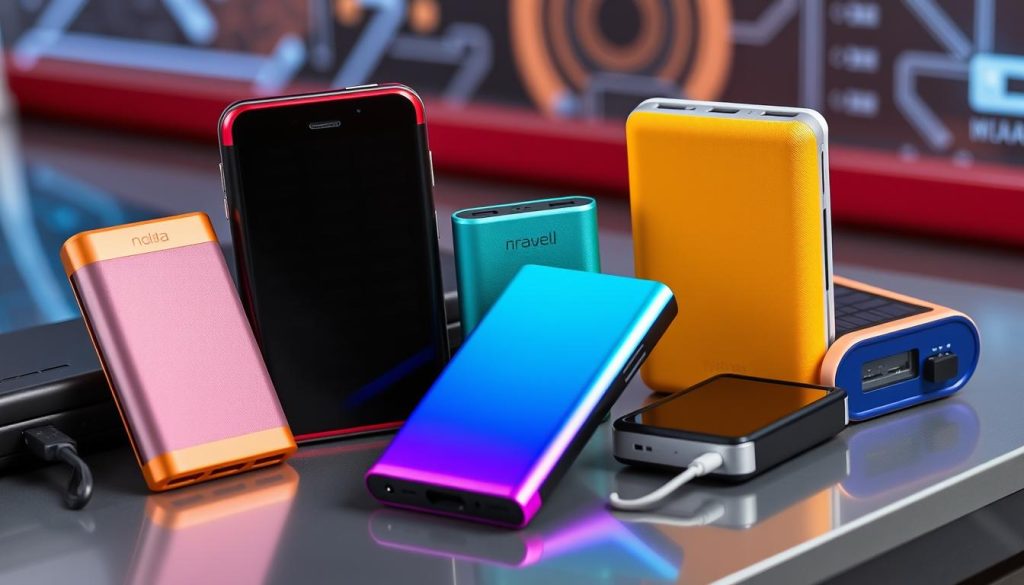
Top Portable Chargers and Battery Packs for 2023
Staying connected is key, and a trustworthy power source is a must. In 2023, top portable chargers lead the market with their great power, efficiency, and handiness. Let’s dive into some of the standout battery packs to consider.
| Product | Capacity (mAh) | Features | Price |
|---|---|---|---|
| Anker 733 Power Bank | 10,000 |
|
$70 |
| Anker Prime | 27,650 |
|
$120 |
| Baseus Airpow Power Bank | 10,000 |
|
$20 |
| Iniu B61 | 10,000 |
|
$25 |
| Nimble Champ Pro | 20,000 |
|
$50 |
The Anker 733 Power Bank shines in 2023 for its efficiency and many ports. Top picks from Nimble and Baseus bring great value, fitting all budgets and needs. Looking for an affordable pick or a high-capacity bank for long use? This year offers plenty of choices to keep your gadgets powered up.
How to Choose the Right Capacity for Your Needs
To pick the right portable charger, think about how much you use your devices. Then work out the total power, measured in mAh, you’ll need. This helps you keep your devices charged longer without needing to recharge too often.
Estimating Device Usage
First, figure out how often and for how long you use your gadgets. For a short day trip like a festival or picnic, get a power bank that holds 6,000mAh to 10,000mAh. This lets you charge your phone a few times easily.
If you’re going on longer trips or hikes and won’t have many chances to charge, choose a power bank with 20,000mAh or more. This way, you can recharge your devices multiple times over longer periods.

Calculating Required mAh
Start by checking your devices’ battery capacity, which is around 3,000mAh for most modern smartphones. Then, figure out how many times you’ll need to charge up. For three charges on a trip, a power bank with at least 9,000mAh is needed. But remember, charging isn’t 100% efficient, so aim for a power bank with 10,000mAh to 12,000mAh to cover losses.
Also, think about whether your gadgets can handle fast charging. If yes, look for a power bank that can charge quickly, with output currents from 2.4A to 3A. This makes sure your devices charge up fast, even if they need a lot of power.
Last, think about size and weight if you need something easy to carry. A small, lightweight power bank, around 5,000mAh, is great for travel and fits easily in your bag. For tougher trips, choose a durable power bank that can deal with rough conditions and still keep your devices charged.
Understanding how much you use your devices and the power they need helps you pick the perfect portable charger for your needs.
Charging Speeds: What You Need to Know
Today, knowing about different charging speeds is key to keep your gadgets powered. Whether you use a portable charger or a wall adapter, the type of USB and charging standards really matter. They can change how fast your devices charge up.
USB-C vs. USB-A
Switching from USB-A to USB-C has made charging faster and more convenient. USB-C offers quicker data transfer and supports more power. This means your smartphones, tablets, and laptops charge faster. For example, a USB-A port charges smartphones at 12 watts, but USB-C can go up to 100 watts. This reduces charging time a lot.
USB-C ports work with many devices, making life easier. USB-C cables are also reversible, so you won’t plug them in the wrong way. So, changing to USB-C makes charging more efficient.
Quick Charge and Power Delivery Standards
Qualcomm’s Quick Charge technology and USB Power Delivery (PD) make charging super fast. Quick Charge has versions, like 3.0 and 4.0, that boost your battery quickly. A Quick Charge 3.0 power bank can charge a device to 80% in just 35 minutes.
USB Power Delivery (PD) also speeds up charging for many devices, from phones to laptops. It lets devices decide how much power they need, making charging fast and safe.
When picking a portable charger, look for ones with Quick Charge or USB PD. They save time and keep your devices going longer by managing power well.
Safety Tips for Using Portable Chargers
Making sure your portable chargers stay safe is key to keeping both your devices and chargers working well. By following simple safety tips, you can dodge hazards like overheating and overcharging.

Preventing Overheating
Understanding how portable chargers function is the first step to prevent overheating. These devices, especially those with lithium-ion or lithium-polymer batteries, can break down if misused. In fact, about 15% of power bank users have had overheating issues.
To prevent this:
- Always keep chargers in well-ventilated areas during use.
- Avoid using chargers in high-temperature environments, which can increase the risk of failure by more than 40%.
- Separate chargers from metal objects and flammable materials to reduce short-circuit incidents by up to 50%.
These steps are essential for preventing overheating and keeping your devices safe.
Avoiding Overcharging
Avoiding overcharging your devices is also crucial for charger safety. Features that prevent overcharging can cut the risk of fire by as much as 60%. Yet, only about 10% of buyers think about the brand’s safety features when choosing a portable charger. To avoid overcharging:
- Always unplug your charger once your device reaches 100% battery.
- Invest in chargers with overcharge protection.
- Regularly check for safety testing certifications on your charger.
Following these charger safety tips can extend the life of your portable chargers and make charging safer.
| Safety Measures | Impact or Benefit |
|---|---|
| Using overcharge protection features | Reduces risk of fire by up to 60% |
| Avoiding high-temperature environments | Decreases malfunction risk by more than 40% |
| Keeping chargers in ventilated areas | Helps in preventing overheating issues reported by 15% of users |
| Separating from metal objects | Reduces short-circuit incidents by 50% |
The Benefits of High-Capacity Chargers
High-capacity chargers are vital for keeping your devices ready to go. They handle multiple devices at once. So whether you’re traveling, experiencing a power cut, or need a backup, you’re covered.

Powerful chargers standout because of their large capacity. For example, some power banks hold up to 50,000 mAh. They can charge devices like tablets and laptops many times. In contrast, smaller ones with about 2,000 mAh are good for charging a phone once.
High-capacity chargers are also easy to carry around. Their design is lightweight. This means they won’t make your bag heavy.
Let’s dive into different high-capacity chargers and what they offer:
| Charger Capacity | Devices Charged | Charge Cycles (iPhone 7) |
|---|---|---|
| 5,000 mAh | Smartphones | 1.5 times |
| 10,000 mAh | Smartphones, tablets | 3 times |
| 15,000 mAh | Smartphones, tablets | 5 times |
| 20,000 mAh + | Smartphones, tablets, laptops | Multiple times |
A high-capacity charger means you worry less. About 30% of people say they feel unsafe without a charged phone when out. Chargers help keep you safe by letting you call for help in emergencies.
Using your own power bank also lowers the risk of cyber-attacks compared to public chargers. They’re affordable, so everyone can get one. They’re key for anyone who uses mobile devices daily.
In short, powerful chargers like high-capacity ones offer many pluses. They give you convenience, safety, and dependability without weighing you down. They’re great for travel or daily use, keeping you connected at all times.
Traveling with Backup Power: What You Need to Know
Learning how to travel with chargers can make your trip easier. Let’s discuss airline rules and the best chargers for travel. This will help you travel smoothly.
Airline Regulations on Portable Chargers
Airlines have clear rules about portable chargers for safety reasons. Knowing these rules is important.
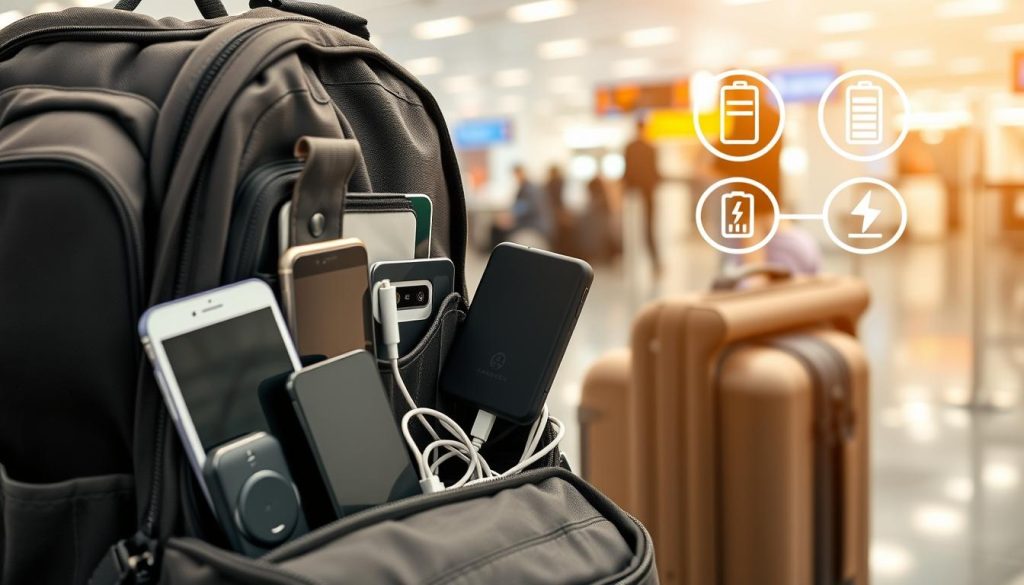
- Lithium-ion batteries rated up to 100 watt-hours are allowed in both carry-on and checked bags.
- Keep spare lithium-ion batteries in your carry-on. They’re not allowed in checked bags.
- You can bring two larger spare lithium-ion batteries (101-160 Wh) if the airline says it’s okay.
- Lithium metal batteries must have less than 2 grams of lithium and be in carry-on bags.
- Non-spillable wet batteries must be below 12 volts, and you can have up to two spares.
- Don’t recharge devices or batteries on the plane.
Travel-Friendly Charger Options
Choosing the right chargers can make your trip easier. Pick chargers that are small, follow airline rules, and have enough power for your devices. These are some good choices:
| Type | Features | Best For |
|---|---|---|
| Portable Power Banks | Small, with a lot of power; often has several USB ports | Any trip, emergency power |
| Solar Chargers | Good for the environment, perfect for outdoor use; charges while you move | Hikes, camping, long outdoor adventures |
| Battery Packs | Can store a lot of power, good for charging many devices | Long flights, working remotely, attending conferences |
Many travelers choose portable power banks first for their trips. These chargers make sure your devices are powered. They also follow airline rules, ensuring a smooth, worry-free trip.
Conclusion
In our busy lives, staying connected has never been more crucial. Having a backup charger means your devices won’t run out of power. There are many types of chargers, such as power banks, to fit different needs.
Choosing the best charger depends on how you use your devices and your travel habits. Options like the Ledlenser Flex3 or Flex5 are great for daily use. For longer trips or charging several gadgets, the Flex10 is a good choice. Ledlenser’s IP65-rated power banks are also tough, making them great for travel.
Having a backup charger boosts your productivity and keeps you prepared. It lets you stay connected or ready for any emergency. This guide helps you find the right charging solution. Remember, quality chargers are more reliable and last longer, matching today’s tech needs.