Outsmart Hidden Fees on Hotels & Flights
Ever noticed how prices for hotels and flights jump up before you finish booking? You’re not alone. Many travelers get surprised by the final cost.
Hidden fees are now common in travel bookings. Finding clear pricing is tough. A shocking 53% of travelers find unexpected fees online. The U.S. White House is fighting excessive junk fees that hide the real cost of travel.
In 2022, 122 airlines made about $102.8 billion from extra fees. That’s why 47% of travelers stop their bookings when they see these fees at checkout. But, there’s hope. Learn how to plan better and save money on travel by avoiding hidden fees.
Understanding the Hidden Fees in Hotels and Flights
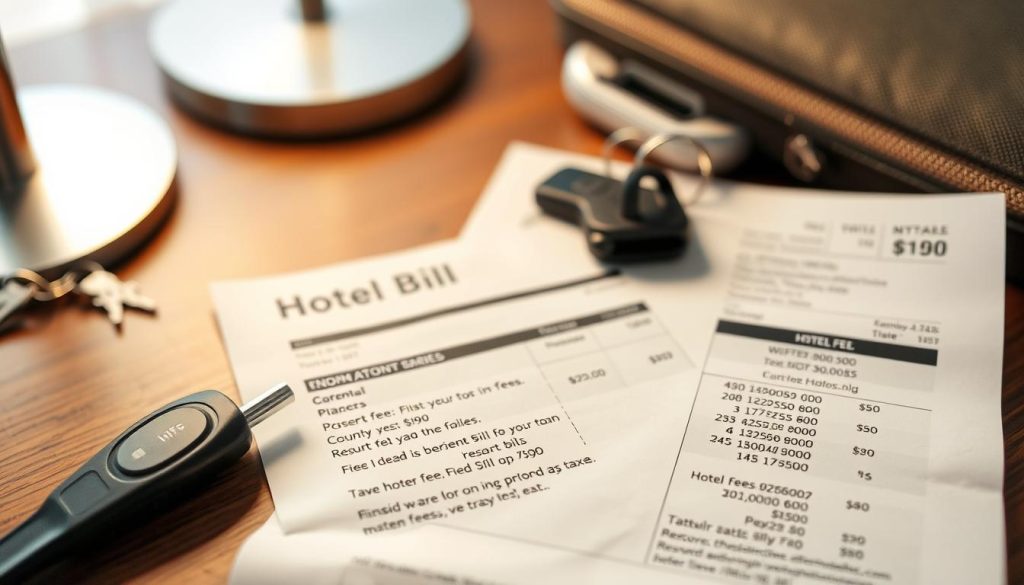
Hidden fees can surprise you and mess up your travel budget. Knowing about these unexpected travel costs helps you plan better. Hotels often add resort fees to your bill. These fees can be from $20 to more than $50 a night. So, they’re a big thing to remember when making your travel budget tips.

Take the Luxor Hotel in Las Vegas as an example. They charge a $45 daily resort fee. This makes your total cost about $80 a day after taxes, even if the room was advertised at $25. On the other hand, a hotel might charge $50 for a room and another $50 as a resort fee. This makes the total $100. It also cuts the commission for online travel agents in half. This “drip pricing” can lead to consumers not making the best choice because they don’t know the full cost upfront.
California is taking steps to fix this issue. It passed laws that require hotels to show all fees in their advertised prices from July 2024. This should make pricing clearer. Yet, hotels still have other hidden fees. These can be for using certain services, adding extra people, or parking. In big cities, parking can cost you $25 to $35 per day, adding up quickly.
Airlines have their own set of hidden fees to watch out for. Southwest Airlines charges you $30 if you want to board early. United Airlines charges $24, and Frontier Airlines up to $12. If you need to print your boarding pass at Spirit Airlines, it’ll cost you $25. Also, Hertz and Sixt might charge you for using a toll transponder. Avoid hotel phone charges by using your cell phone for calls.
The Federal Trade Commission (FTC) has noticed that separating fees from the room rate can harm consumers. They urge for more rules on this. Hotels and airlines together make billions each year from these fees. So, knowing and avoiding them with travel budget tips can save you a lot of money.
| Type of Fee | Cost Range | Example |
|---|---|---|
| Resort Fees | $20 – $50 per night | Luxor Hotel: $45/day |
| Early Boarding (Airlines) | $12 – $30 | Southwest: $30 |
| Additional Person Fee | $20 – $50 per adult per night | Varies by hotel |
| Parking Fees | $25 – $35 per day | Major city hotels |
| Phone Surcharges | Various | Local & long-distance calls |
Knowing about these unexpected travel costs is key. Stay alert while planning your trips. Use these *travel budget tips* to avoid hidden fees and keep your journey’s cost under control.
Smart Ways to Avoid Hidden Fees in Hotels and Flights
Managing your travel funds can be tricky with hidden fees. Here are tips to dodge these charges and keep your travel budget management on track.

Know the Airlines’ Policies: Airlines like United, American, and Delta have basic economy fares. These may not include things like carry-on bags and choosing seats. It’s wise to know these rules to avoid unexpected fees.
Optimal Booking Times: Expedia’s 2024 Air Travel Hacks report has tips for saving money on flights. Book international trips 60 days ahead. For within the country, book 28 days early.
Flight Timing Tips: Morning flights usually cost less and are on time more often than later flights. Flying on Thursdays instead of Sundays can also cut costs by up to 16%.
Setting Price Alerts: Use tools like Hopper, Kayak, and Google Flights for price alerts. They tell you when prices drop, so you grab the best deals without always checking.
Utilize Multiple Aggregators: Check different sites to compare flight prices. Often, one site might offer a deal that others don’t. Keep your options open.
| Airline | Basic Economy Restrictions | Average Baggage Fee |
|---|---|---|
| United Airlines | No carry-on bags, limited seat selection | $30 for the first bag, $40 for additional bags |
| American Airlines | No carry-on bags, no seat selection | $30 for the first bag, $40 for additional bags |
| Delta Airlines | Limited seat selection | $30 for the first bag, $40 for additional bags |
Explore Alternative Booking Methods: Try Skyscanner’s “explore everywhere” feature. It shows cheaper flights and places you might not have thought of.
Check Nearby Airports: Using another airport might save you money, despite some extra travel. It’s worth looking into for big savings.
Monitor Prices Post-Booking: Keep watching ticket prices even after you book. If prices drop, you might get a refund or credit. This is possible with features like Expedia’s price-drop protection.
With these strategies, you can control your travel budget better. Avoid those annoying hidden fees for a smoother trip.
Common Hidden Hotel Fees and How to Avoid Them
80% of guests often face unexpected charges at hotels. These may include paying for parking, resort taxes, or Wi-Fi. Knowing about these fees and using money-saving tips can really help your budget.
Resort fees can be a shock, ranging from $10 to $50 each day. These fees usually cover gym use, pools, and internet. To avoid them, check what your booking includes. Pick hotels that don’t have extra charges. Or choose places with all-inclusive rates for simpler budgeting.
Parking can cost a lot in city hotels, sometimes up to $40 a day. To save money, find hotels that offer free parking. Or consider other ways of getting around like buses or ride-sharing.
“Premium” Wi-Fi fees are common even if basic internet isn’t free. To skip these costs, stay at hotels with complimentary Wi-Fi. Or join their loyalty programs for free internet access.
Items from the minibar are super expensive, costing three times more than usual. Avoid this by buying snacks at a local store before you check in.
Fees for checking in early or late can add up, from $25 to $50. Avoid these by planning your travel times carefully. Or talk to the hotel beforehand.
Here is a comprehensive table detailing common hidden fees and tips to avoid them:
| Fee Type | Description | Cost-Saving Strategy |
|---|---|---|
| Resort Fees | Charges for amenities like Wi-Fi, pool, gym | Confirm amenities in booking; choose hotels with included services |
| Parking Fees | Daily parking charges in city hotels | Find hotels with free parking; use public transport |
| Wi-Fi Charges | Fees for “premium” internet services | Stay at hotels offering free Wi-Fi; join loyalty programs |
| Minibar Charges | High-priced in-room snacks and drinks | Buy snacks outside the hotel |
| Early/Late Check-In | Fees for checking in early or late | Plan around check-in times; negotiate with hotel |
These money-saving tips ensure a budget-friendly stay without any hidden fee surprises during checkout.
Identifying Hidden Airline Fees Before Booking
Finding a flight often feels overwhelming, mainly when airline fees come into play. Understanding these fees can significantly impact your budget flight booking. Many travelers find unexpected costs when buying tickets, which raises the total trip cost.
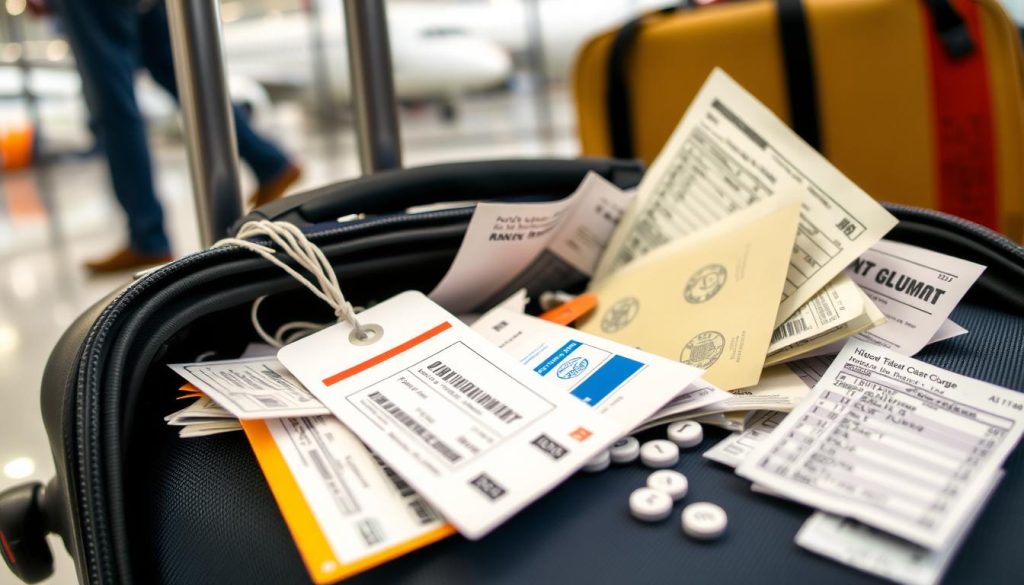
Airlines add service charges for various payment methods. These charges vary by airline. Non-refundable tickets may look cheap at first, but cancellation can cost over $200. Choosing your seat can cost between $5 and $100. This depends on the airline and where the seat is on the plane.
| Airline Fee | Price Range | Details |
|---|---|---|
| Seat Selection | $5 – $100 | Varies by airline and seat |
| Checked Baggage | Up to $60 per bag | Charges can add up, especially with multiple bags |
| Overweight Luggage | $100+ | Penalties for exceeding weight limits |
| Currency Conversion Fees | 1% – 3% | Applies when using foreign currency |
| Change/Cancellation Fees | $200+ | Applicable to changes in itinerary |
Baggage fees often surprise travelers. Even though international flights may include one free checked bag, some airlines charge up to $60 for checked bags on domestic flights. Also, if your bags are over the weight limit, you might pay $100 or more for each one.
- Service Fees: Variable rates depending on the airline and payment method.
- Checked Baggage Costs: Significant fees for exceeding baggage limits.
- Seat Selection Charges: Additional costs for preferred seating arrangements.
- Non-refundable Tickets: Risk of high cancellation fees.
Airlines like Southwest don’t add a fee for choosing seats, showing how rules differ among airlines. It’s wise to look at different airlines’ policies to see which offer free checked bags or more flexible services.
Joining loyalty programs or using certain credit cards can help avoid some fees. Making smart choices in budget flight booking can lessen the financial stress and keep your travel costs low.
Booking Strategies to Avoid Hidden Fees
Using smart booking strategies can really help dodge hidden fees. Booking directly with hotels like Hilton and Hyatt is good. They often skip resort fees for award stays. This can save a lot of money for people who travel a lot.
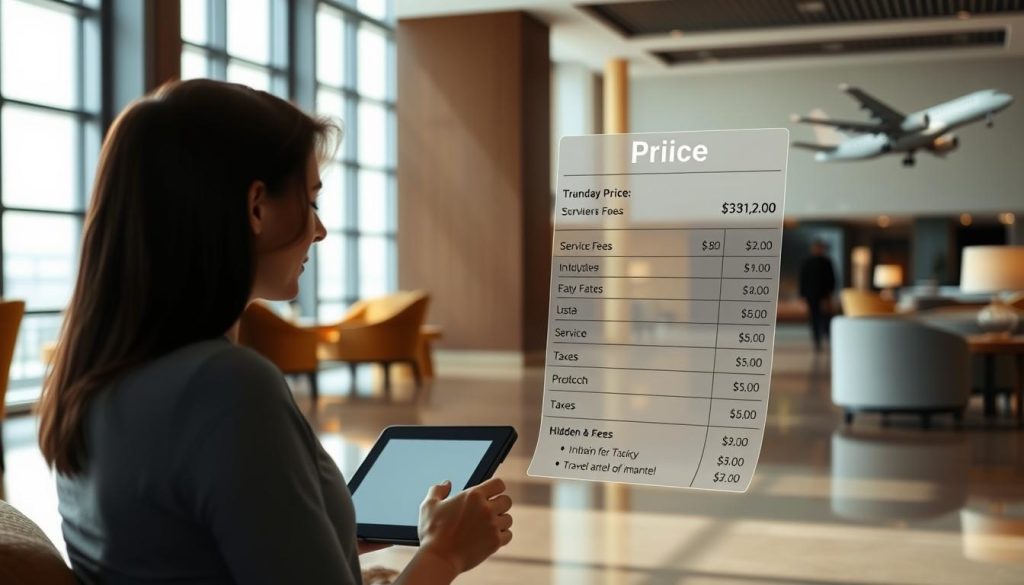
A great way to avoid hidden fees is to carefully read terms and conditions before you book. About 64% of travelers don’t check the fine print, which leads to unexpected charges. Knowing cancellation policies is also important. Only 30% are aware of their hotel’s policies, which can cost a lot if travel plans change.
It’s key to watch out for third-party fees too. Booking through trusted websites or directly with the hotel helps see the real cost. This avoids extra fees that come with third-party platforms. Using price comparison sites can make accommodation 15% to 20% cheaper. Loyalty programs can also give up to 25% off for returning customers.
Here’s a breakdown of how different booking strategies can help you avoid hidden costs:
| Strategy | Potential Savings |
|---|---|
| Direct Booking | Up to 25% through loyalty programs |
| Reading Terms and Conditions | Elimination of surprise fees |
| Early Bookings | Up to 30% savings on flights and hotels |
| Using Comparison Sites | 15% to 20% reduction in accommodation costs |
| Off-Peak Travel | 20% to 50% savings |
Adopting these strategies can really cut down on hidden fees for a cheaper, clearer travel experience.
Using Online Tools to Discover Hidden Fees
Using online booking tools cuts down on hidden fees in your travel budget. These tools show the real cost upfront. A round-trip flight on Bing seemed to be $380, but the true cost was actually $947. This shows how vital transparency is.

AI-powered tools are super helpful too. An AI found a round-trip for $570, saving $530 compared to a $1,100 flight found the usual way. Booking.com had rooms from $672, but AI found hostels for $65 a night. This saved $250 over the same time.
AI helps save money on activities too. Savings on tickets for places like Broadway and museums added up to $131. In total, AI and booking sites saved $911, with $780 from bookings and $131 from AI suggestions.
While AI chatbots are convenient, they are not as accurate as specific flight search engines. But, the clear pricing from online booking tools is super important.
| Booking Tool | Claimed Price | Actual Price | Savings |
|---|---|---|---|
| Bing | $380 | $947 | – |
| AI Travel Tool | $570 | $1,100 | $530 |
In the end, using transparent pricing resources from online tools and AI reveals hidden fees. This way, you’re not caught off guard by high costs.
Dynamic Pricing: Understanding and Avoiding It
Dynamic pricing is when hotel or airfare rates change based on the market. Prices can change daily or hourly because of demand and competition. In contrast, static rates are more constant. They include regular weekday prices, higher weekend rates, and peak season costs that rarely change.
To beat dynamic pricing, remember some key tips. Book flights early to avoid high last-minute fees. Skipping travel during busy times can also lead to savings. Watching prices before buying may reveal a better deal later.
For hotels, dynamic pricing can both lower and raise rates. When demand is low, prices might drop to get more bookings. But in busy times, prices can jump 15% to 30%. This can fill hotels 90% to 100% during big events, much higher than the usual 70% to 80%. However, when prices change too much, it can confuse customers and bookings might fall by 25%.
Airlines use dynamic pricing too, affecting extra fees. For example, JetBlue might charge $5 to $10 more for checked bags during busy times. Knowing these tips can help you avoid extra charges. By understanding these strategies, you can make smarter choices and save money.
Surveillance Pricing: Protecting Your Privacy
In today’s digital age, privacy during travel bookings is crucial. Factors like your IP address, browsing history, zip code, and Wi-Fi connection can change online prices. This is called surveillance pricing. It can make flights and hotels more expensive. Knowing how to protect your data is key to avoid this.
Travelers are often targeted by digital scams. That’s why strong protective steps are essential. Using a Virtual Private Network (VPN) can hide your location. This stops airlines and hotels from changing prices based on your data. For instance, changing your IP to London could make a New York to London flight cheaper. It could go from $417 to about $370, saving you $47.
Staying off public Wi-Fi is also important. It can lead to data breaches. Using a VPN helps. Losing or having your devices stolen is another risk. Carry only what you need to keep your info safe.
Here are tips to keep your data safe while traveling:
- Use a VPN to hide your location and secure your internet.
- Stay away from public Wi-Fi, or use a VPN on it.
- Only carry essential cards, like one credit card and ID.
- Check your card activity often and report any strange charges.
- Prefer credit cards and cash over ATM cards.
- Be careful with USB chargers; use power bricks instead.
- Check your card statements and change passwords after trips.
By doing these things, you can protect your personal information. This helps control travel costs. It ensures a safer, more affordable trip.
Credit Card Strategies for Travelers
Travel credit cards can enhance your travel experience and reduce hidden costs. They can cover expenses like baggage fees and lounge access, saving you lots of money.
Airlines may charge $25 to $35 for each checked bag, which adds to your travel costs. Using credit cards that waive these fees can help make your budget last longer. For example, the Delta SkyMiles Platinum American Express Card offers a free round trip ticket annually, with very low fees.
Also, cards without foreign transaction fees are great for trips abroad. They help you avoid extra charges that can be 1% to 3% of your purchases. This saves a lot on international spending.
Some credit cards offer trip cancellation insurance and rental car insurance, which can save you money. For instance, you can avoid rental company insurance fees, about $20 a day.
Here’s a comparative look at top credit cards that enhance travel experiences and offer substantial savings:
| Credit Card | Key Benefits |
|---|---|
| Delta SkyMiles Platinum American Express Card | Companion certificate, no foreign transaction fees, primary rental car insurance |
| Alaska Airlines Visa Signature Credit Card | Companion fare with $6,000 spending threshold, airline fee credits |
| Chase Sapphire Reserve | Annual travel credit, airport lounge access, global entry/TSA Pre-check fee credit |
| American Express Platinum Card | Airline fee credits, extensive lounge access, annual travel credit |
In 2018, airlines made nearly $28.1 billion from baggage fees, much more than $13.4 billion in 2014. This shows why it’s smart to use travel credit cards. They help avoid fees and offer rewards that make your travel better.
Utilizing Loyalty Programs to Mitigate Fees
If you’re part of the 86% of travelers who’ve faced hidden fees, there’s a way out. Joining airline and hotel memberships offers many loyalty programs benefits. These can cut your travel expenses a lot.

Loyalty programs can remove extra costs like resort fees. Frequent flyers enjoy perks such as no baggage fees, fast check-in, and less change fees with these memberships.
Budget airlines often have low ticket prices but charge extra for seat selection and bags. Their fees can really increase your ticket cost. But, loyalty programs can remove these extra charges, giving free services and special deals.
Hotel memberships offer room upgrades and lower rates for amenities. In places with high hotel taxes, these programs can save you money on those extra charges.
- Loyalty programs can remove fees for amenities you might not use.
- They also provide seat upgrades for a better travel experience.
- Specific airline memberships give you free baggage, saving you money on luggage fees.
Co-branded airline credit cards make earning points quicker. You can use these points for free flights or other costs. These cards include benefits like free checked bags, helping avoid hidden fees.
Being active with your airline and hotel memberships could save you up to 30% on flights. About 70% of flyers belong to loyalty programs. Yet, only 33% use their rewards well. It’s crucial to learn how to use your points for the best benefits.
Knowing how to use loyalty programs wisely can cut your travel costs. It also avoids the hidden fees that upset many travelers.
Government Initiatives to Combat Junk Fees
On February 1, 2023, the Biden administration released a fact sheet about “junk fees.” It outlines actions with agencies like the Consumer Financial Protection Bureau (CFPB) and Federal Trade Commission (FTC). The CFPB wants to change *Regulation Z* under the *Credit Card Accountability Responsibility and Disclosure (CARD) Act of 2009*. This change would lower late fees on credit cards. Instead of $30 for the first late payment and $41 after, the rule would cap fees at $8. Late fees would also be limited to 25% of the minimum payment.
The Biden administration highlighted that service fees for event tickets can be over 20% of the ticket’s price. Sometimes, total fees can go up to 50%. They also found that 80 of the top 100 arenas have deals with just one ticket seller. This limits choices and competition for consumers.
There’s also a plan to get rid of early cancellation fees for TV, phone, and internet services. This would make it easier for consumers to switch providers and boost competition. The administration wants to forbid unexpected resort and destination fees, which can be over $50 a night. They aim for clear pricing to help consumers shop and compare better.
The Department of Transportation (DOT) says children 13 and younger should sit next to an adult for free. They’re looking at fees airlines charge for family seating. Congress is also thinking about the Junk Fee Prevention Act. This would tackle high fees and improve fee disclosure in areas like travel and entertainment.
The FTC believes the new rule could save consumers billions of dollars and millions of hours. President Biden said hidden fees take money from Americans. The DOT and FTC are proposing more actions. These could affect airline fees for family seating and luggage. They’re working toward clearer pricing in various sectors.
| Agency | Initiative | Estimated Impact |
|---|---|---|
| CFPB | Regulation Z amendment | Reduces late fees on credit cards |
| FTC | Mandatory fee disclosure | Billions saved for consumers |
| DOT | Family-seating regulations | No extra charges for children |
| Biden Administration | Junk Fee Prevention Act proposal | Enhanced fee disclosure, consumer protection |
In January 2023, AARP asked the Transportation Department to finalize rules for consumer protection against heavy travel fees. With new FTC rules on junk fees coming soon, there’s a big effort to enforce transparency laws across various industries.
Tips for Dealing with Hidden Fees on Rental Cars
Hidden fees can really bump up the cost of renting a car. Being prepared and knowing what to look for is key. Here are ways to tackle rental car fees and find budget-friendly options.
Watch out for mileage limits first. Going over the limit can cost you, as some companies charge up to $0.50 extra per mile. Toll charges can also be steep. For instance, a person using Dollar Rental Car got billed $59.99 for just one toll. Using your own toll transponder can help avoid this.
The location where you pick up and drop off the car affects the cost too. Avoid airports to skip higher fees. Also, changing your return location can triple your rental price.
“Rental car insurance from the rental company might lead to additional costs around $200 especially if your personal car insurance or credit card already offers rental coverage.”
To cut costs on insurance, check if your credit card or personal insurance covers rentals. This could save you a lot. Stick to one driver to dodge extra fees. Also, booking directly can keep your rewards and points safe.
Skip the extras to save money. Stuff like car seats or GPS can make your bill jump. For example, adding extras with Alamo for two days upped the cost by $117. And, choosing frequent flyer miles over rental points adds $0.75 to $1.50 daily.
Making sure the car is damage-free before you drive off is vital. If you don’t, you might pay for any damages later. Companies like Avis offer a grace period for returns. Still, check the details to avoid late fees.
Finally, fill up the gas tank before returning the car. Rental places charge more than local rates for gas. Paying for gas upfront often means paying more, even if you don’t use it all.
Keep these tips in mind to handle rental car fees better. You’ll enjoy a more wallet-friendly rental experience.
Conclusion
Traveling can have hidden costs, but knowing how to handle them helps a lot. The key is to learn about unexpected fees in hotels and airlines. For example, resort fees can increase your bill by $20 to $50 each night.
Online tools and knowing about pricing can help you choose wisely. Keep an eye on pricing that changes depending on what you look at online. This protects your wallet. Also, joining loyalty programs can cut or remove surprise fees, like parking costs in big cities.
Now, the government is working to stop unnecessary fees. This is good news for travelers. Still, it’s smart to check with hotels about any extra charges yourself. This way, you won’t be caught off guard by things like Wi-Fi fees, which can be up to $20 a day. Airlines might not include some things either, so always read the details carefully.
With smart planning and budgeting for travel, you can avoid those unexpected charges. This means more fun on your trips. Learning about booking tips, credit card benefits, or using buses and trains can change your traveling game. It all leads to a smoother, less costly adventure.