South Korea’s Economic Development Insights
If you are interested in exploring one of the world’s most impressive economic growth stories, you have come to the right place. South Korea’s economy has undergone an incredible transformation over the last few decades, becoming a leader in many industries. In this section, we will delve into the key aspects of South Korea’s economic development and explore the factors driving its success. Through examining the past, present, and future of the South Korean economy, you will gain valuable insights into the remarkable story of this country’s growth. So, let’s get started and discover the secrets behind South Korea’s economic success!
Historical Background of South Korea’s Economy
Understanding the historical background of the South Korean economy is crucial to comprehending its current success. In the mid-20th century, South Korea’s economy was mostly agricultural and was severely weakened by the Korean War. South Korea’s economic fortunes turned around in the 1960s when the government implemented economic reforms to stimulate growth.
The country’s industrialization drive began in the 1970s and was instrumental in shaping the economy. The government implemented policies that supported manufacturing and export-oriented industries, and investments in education and infrastructure. This led to a massive growth in South Korea’s economy, and the country transformed from a developing country to one of the world’s most advanced economies.
| Economic Reforms in South Korea | Impact on South Korean Economy |
|---|---|
| Land Reform | Redistribution of land, leading to increased food production |
| Export Promotion | Shift towards export-oriented manufacturing industries, leading to growth in exports, job creation, and increase in foreign exchange earnings |
| Heavy and Chemical Industries Drive | Development of heavy and chemical industries that fueled the country’s economic growth |
The economic reforms implemented by the South Korean government were a key driver of the country’s economic growth. The government played a critical role in promoting economic growth and development by investing in infrastructure, supporting small and medium-sized enterprises, and creating a favorable environment for foreign investment. Overall, South Korea’s economic development is a remarkable success story that is shaped by a combination of government policies, industrialization, and investment in human capital.
Government Policies and Economic Success
South Korea’s economic development owes much to the government policies crafted over several decades. In the 1960s, the government launched a series of economic plans that encouraged industrialization and exports. The first five-year plan (1962-66) focused on the establishment of a structural foundation for the economy, while the following five-year plan (1967-71), which aimed at expanding Korea’s industrial base, led to significant investment in heavy industries such as steel, shipbuilding, and petrochemicals.
The government also adopted pragmatic policies such as putting in place laws and regulations that fostered a favorable business environment, including loosening restrictions on capital and foreign investments. The South Korean government has also implemented measures to support technological innovation and entrepreneurship, including R&D spending and patent protection laws.
With these policies in place, South Korea embarked on an impressive development path, which produced successful businesses such as Samsung, LG, Hyundai, and SK Group. Industrial production surged, and the country joined the Organisation for Economic Co-operation and Development (OECD) in 1996 as the first former aid recipient to do so.
Impact of Government Policies on Economic Growth
The government’s policies had a tremendous impact on the growth of the South Korean economy. In the 1960s, the economy grew at an annual rate of approximately 8%, and by the 1970s, this had risen to around 9%. In the 1980s and 1990s, the economic growth rate averaged around 10.7% and 6.8%, respectively. Between 1960 and 1996, South Korea’s gross domestic product (GDP) grew from $2.7 billion to $339.4 billion.
Through these policies, the South Korean government has transformed an agrarian economy dependent on foreign aid into a globally competitive high-tech economy. Today, the country is a leading producer of electronic goods, semiconductors, cars, and steel. South Korea’s GDP growth for 2021 is projected to be around 3.5%, a commendable figure given the challenges posed by the COVID-19 pandemic.

The table below shows South Korea’s GDP growth rates for selected years from 1962 to 2020.
| Year | GDP Growth Rate (%) |
|---|---|
| 1962 | 6.9 |
| 1974 | 12.3 |
| 1986 | 12.8 |
| 1998 | 5.9 |
| 2010 | 6.3 |
| 2020 | 0.9 |
In conclusion, South Korea’s government policies have been instrumental in driving the economic success of the country. The adoption of pragmatic policies such as investment in R&D, favorable business regulations, and heavy industry funding have fostered a competitive business environment and allowed South Korea to become a global economic powerhouse.
The Role of the Export Sector
South Korea’s economic success can be attributed to various factors, including the significant role played by its export sector. By focusing on exporting goods and services, South Korea has been able to achieve substantial economic growth and development. In this section, we will explore the strategies employed by South Korea to develop and strengthen its export industry.
One key factor contributing to South Korea’s success in the export sector has been the government’s focus on developing key sectors such as electronics, automobiles, and shipbuilding. In addition, the country has also leveraged its geographical location and developed strong trade relationships with key partners, such as the United States and China.
| Category | Percentage of Total Exports |
|---|---|
| Semiconductors | 19.1% |
| Petroleum Gas | 5.3% |
| 3.9% | |
| Automobiles | 3.3% |
The table above shows the top exports from South Korea in 2020, according to data from the Observatory of Economic Complexity. South Korea’s export industry is diverse, with semiconductors being the largest category, accounting for almost one-fifth of the country’s total exports. Petroleum and automobile exports were also significant contributors to the country’s exports.
Another strategy employed by South Korea to support its export industry is the establishment of free trade agreements with various countries and regions such as ASEAN, the EU, and India. This has helped the country to gain preferential access to markets, reduce trade barriers, and increase its competitiveness in the global marketplace.
The technological advancements made by South Korea have also been a driving force behind the country’s export success. This is particularly evident in the electronics sector, where South Korean companies such as Samsung and LG have become global leaders in the production of smartphones, televisions, and other electronic devices.
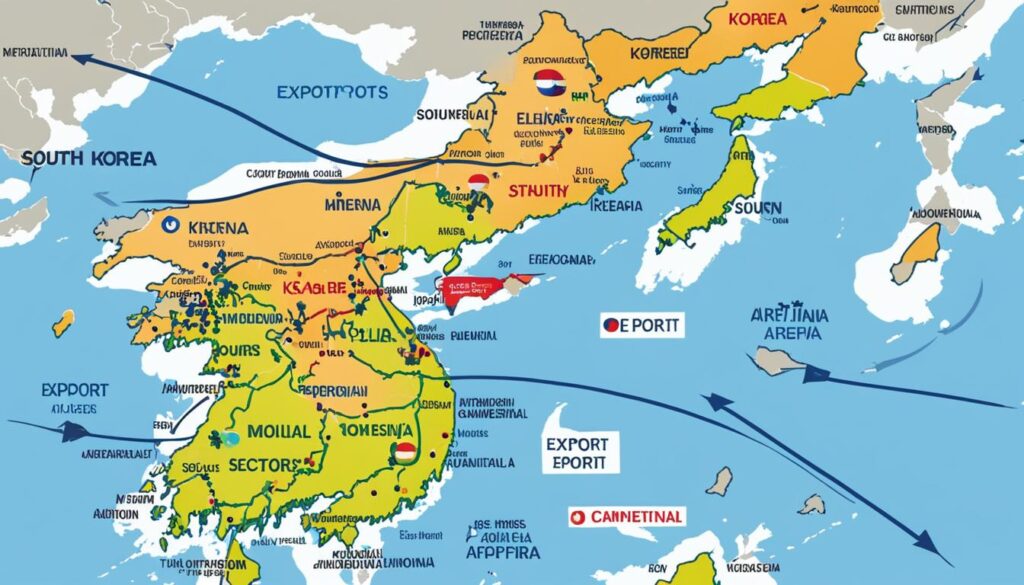
As the world continues to evolve, South Korea’s export sector faces numerous challenges that need to be addressed. These include rising labor costs, competition from emerging economies, and increasing demand for eco-friendly products. Nevertheless, through its innovative strategies and focus on technological advancement, South Korea’s export sector is well-positioned to continue driving the country’s economic success in the years to come.
Technological Advancements in South Korea
South Korea’s economy owes much of its success to the impressive technological advancements made over the years.
The country has consistently invested in research and development in various fields, such as information and communication technology, nanotechnology, and biotechnology, among others.
One notable area where South Korea has excelled is in the semiconductor industry, with companies like Samsung and SK Hynix leading the way.

This image depicts the impressive growth of South Korea’s semiconductor exports.
The development of 5G networks is another area where South Korea is leading the way, having rolled out nationwide 5G coverage in 2019, making it the world’s first country to do so.
Examples of Technological Advancements in South Korea
| Field | Notable Advancements |
|---|---|
| Information and Communication Technology |
|
| Nanotechnology |
|
| Biotechnology |
|
The technological advancements made in South Korea have not only driven the country’s economic growth but have also positioned it as a leader in various industries on a global scale.
Foreign Direct Investment in South Korea
Foreign direct investment has significantly contributed to South Korea’s economic development, playing a pivotal role in the country’s growth and expansion. Through foreign investment, South Korea has been able to secure new capital, technologies, and management expertise to augment its already robust economy. These investments have also helped to create new jobs, increase exports, and stimulate economic growth in various sectors, including technology, automotive, and semiconductors.
The impact of foreign investment on South Korea’s economic growth cannot be overstated. Between 1962 and 1999, for example, the government implemented investment promotion policies to attract foreign investment in industries such as petrochemicals, electronics, and steel. These policies contributed to the growth of industries, led to the transfer of advanced technologies, and promoted competition and efficiency in these sectors.
Foreign investment has also played a critical role in the development of special economic zones such as the Incheon Free Economic Zone, where over 70 multinational companies have invested. These zones have become hubs for research and development, entrepreneurship, and innovation, attracting high-quality human resources and advanced technologies to South Korea.
Top Five Countries Investing Directly in South Korea (2020)
| Rank | Country/Region | Amount (USD Million) |
|---|---|---|
| 1 | United States | 18,492 |
| 2 | Luxembourg | 11,909 |
| 3 | Japan | 9,617 |
| 4 | United Kingdom | 7,380 |
| 5 | China | 4,860 |
The United States, Luxembourg, and Japan are the top investors in South Korea, contributing billions of dollars to the country’s economic growth. The United States holds the largest volume of foreign direct investment in South Korea, with an investment amount of over USD 18 billion in 2020. Luxembourg follows in second place with a USD 11 billion investment, while Japan comes in third with almost USD 10 billion invested.
The availability of a skilled workforce and a favorable business environment continue to make South Korea an attractive destination for foreign investment. These investments will continue to be crucial in driving South Korea’s future economic development and growth.
Education and Skilled Workforce
In South Korea, education is highly valued and prioritized, playing an essential role in the country’s economic success and growth. A well-educated and skilled workforce has been critical to driving South Korea’s impressive economic development. Notably, the nation has consistently ranked high in international education tests such as the Programme for International Student Assessment (PISA).
The government invests heavily in education, with a focus on science, technology, engineering, and math (STEM) fields. The country boasts a strong university system, with institutions such as Seoul National University, Korea University, and Yonsei University among the most prestigious in Asia.
The emphasis on education has resulted in a highly skilled workforce, well equipped to meet the demands of the country’s economic sectors. Notably, South Korea has developed a highly successful manufacturing industry, with companies such as Samsung, Hyundai, and LG Electronics among its most prominent exports.
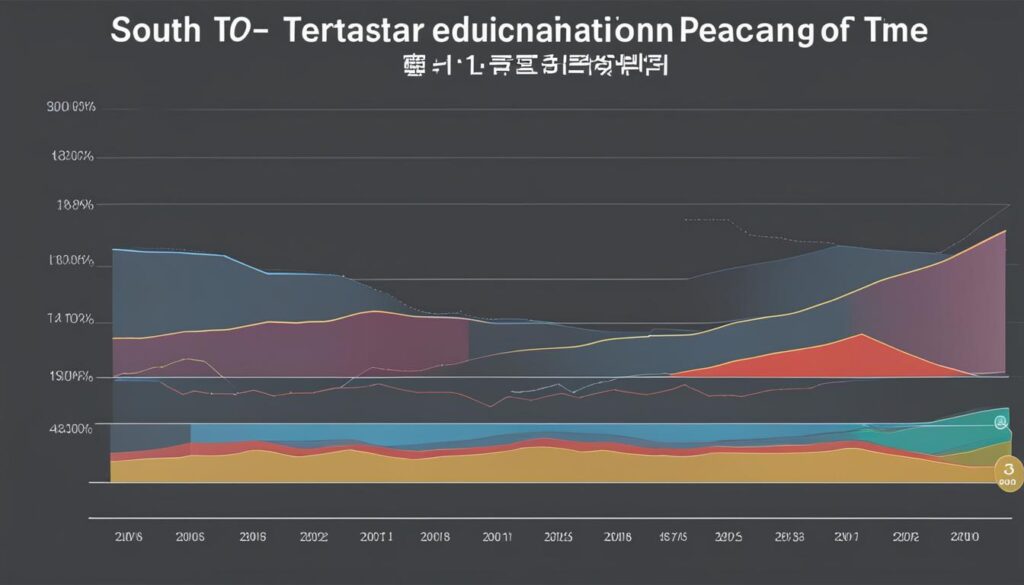
The table below highlights the percentage of the South Korean population with tertiary education, showcasing the nation’s strong commitment to education:
| Year | Tertiary Education Percentage |
|---|---|
| 2000 | 22.2% |
| 2010 | 35.7% |
| 2020 | 51.2% |
The table shows a steady increase in the percentage of the South Korean population that has attained tertiary education, highlighting the government’s commitment to education and the development of a skilled workforce.
The success of South Korea’s economic development can be attributed, in part, to its investment in education and the creation of a highly skilled workforce. As the country continues to prioritize education and skills development, it is well-positioned to sustain its impressive growth trajectory and secure a prosperous future.
Sustainable Development and Environmental Concerns
South Korea’s quest for economic development has been successful, but it has also posed challenges on the environmental front. The Korean peninsula has been subjected to significant environmental damage due to rapid urbanization and industrial growth over the years.
To address these concerns, the South Korean government has implemented several measures to promote sustainable development, reduce pollution and protect the environment.
One such measure is the Green New Deal, a large-scale initiative aimed at promoting the production of eco-friendly products and services while creating new jobs.
“The Green New Deal aims to fundamentally transform our economy, decarbonize our society, and build resilience against future crises,” said President Moon Jae-in in a statement.
Additionally, the government has prioritized investing in renewable energy sources such as solar and wind power, with the goal of significantly reducing reliance on fossil fuels. In 2019, South Korea announced a plan to increase the share of renewable energy in its total power generation to 35% by 2040.
This image represents the reduction of CO2 emissions by country and region until 2030. South Korea has pledged to reduce its greenhouse gas emissions by 37% by 2030 as part of the country’s commitments under the Paris Climate Agreement.
In conclusion, addressing environmental concerns is a critical aspect of achieving sustainable economic growth. South Korea’s efforts to promote sustainable development through policy reforms and investment in renewables will not only benefit the environment but also provide new opportunities for industries and job creation, further fostering economic growth.
Challenges and Opportunities for South Korea’s Economy
Despite the impressive economic success of South Korea, the country still faces a number of challenges and opportunities for further growth and development.
- One of the biggest challenges facing South Korea’s economy is the rapidly aging population, which presents a threat to the country’s future workforce and economic growth. This could potentially lead to negative demographic changes, including a shrinking tax base and decreasing demand for goods and services.
- Another significant challenge for South Korea is the country’s heavy reliance on its export industry, which can make it vulnerable to external market fluctuations and global trade tensions.
- Additionally, South Korea’s economy has been impacted by recent political tensions with neighboring countries, including Japan and North Korea, which could affect both foreign investment and international trade.
Despite these challenges, there are also opportunities for South Korea’s economy to continue to thrive. For example:
- South Korea is widely recognized as a global leader in technology and innovation, which presents significant potential for growth and development in industries such as artificial intelligence, robotics, and biotechnology.
- The country’s strategic location in Northeast Asia makes it an important hub for international trade and investment, with potential for growth in areas such as renewable energy and smart cities.
- There are also opportunities for South Korea to deepen economic ties with neighboring countries, such as China and Russia, through initiatives such as the Belt and Road Initiative and the Eurasian Economic Union.
As South Korea continues to navigate its economic future, it will be essential for the country to address its challenges while also leveraging the opportunities presented by new technologies, international partnerships, and other factors that can drive continued economic growth and success.
Future Outlook for South Korea’s Economy
South Korea’s economy has grown tremendously over the past few decades, with GDP increasing from $30 billion in the 1960s to over $1.6 trillion in 2021. Looking forward, South Korea’s GDP growth is expected to continue, albeit at a slower rate than in previous years.
Despite the COVID-19 pandemic’s adverse impact on the global economy, South Korea’s economy has shown remarkable resilience with positive GDP growth in 2020. Furthermore, the South Korean government’s new initiatives aim to stimulate economic growth in the future, particularly through investment and R&D programs.
One potential area of future development is the green economy, as South Korea has recently announced plans to transition to a low-carbon society and reduce its reliance on fossil fuels. This transition presents exciting opportunities for investment in renewable energy, new technology, and green infrastructure.
However, challenges remain, such as the rapidly aging population, which may put a strain on the workforce and lead to a slowdown in economic growth. Additionally, geopolitical tensions and trade disputes with neighboring countries may also hinder future economic development.
The Future of South Korea’s Economy in Numbers
| 2020 | 2021 | 2022 | |
|---|---|---|---|
| GDP Growth | +1% | +4.0% | +2.5% |
| Inflation | 0% | +1.0% | +1.5% |
| Unemployment Rate | 3.8% | 3.6% | 3.5% |
Table: Projected Economic Indicators for South Korea (source: IMF)
Overall, South Korea’s economy has a promising future despite challenges and uncertainties, with a stable government, skilled workforce, and a focus on technological advancements and sustainability. As the country continues to adapt to global changes and pursue new opportunities for growth, it is likely to maintain its position as an economic leader in the region and beyond.
Conclusion
In conclusion, South Korea’s economic success and development are the result of a combination of various factors. The government’s strategic policies, focus on education and skilled workforce, and technological advancements have played a significant role in driving economic growth. Additionally, the export sector and foreign direct investment have contributed to the country’s success.
However, South Korea still faces challenges relating to sustainable development and environmental concerns and must work to address them. Opportunities for future growth and development exist, and the country must continue to be proactive in addressing these challenges and seizing potential opportunities.
Overall, South Korea’s economic journey serves as a model for other countries seeking to achieve economic success. By embracing strategic policies, investing in education and technology, and developing a skilled workforce, countries can achieve sustainable economic growth and development.