

Master Basic Chinese Phrases for Your Travels
Are you planning a trip to China soon? Learning basic Chinese phrases for travel is an excellent way to ensure a seamless and enjoyable adventure. Whether you’re exploring the bustling cities or rural areas, having some essential language skills can make a significant difference in your experiences.
Knowing how to order food, ask for directions, and interact with locals in their language can help you navigate China with confidence and increase your chances of making meaningful connections. In this article, we’ll provide you with a comprehensive guide to learning the most useful Chinese travel phrases to enhance your trip.
From essential phrases for beginners to cultural etiquette and polite expressions, you’ll find everything you need to know to master basic Chinese phrases for travel. Let’s get started!
Why Learn Chinese Phrases for Travel?
Traveling to China can be an incredible and enriching experience, but it can also be overwhelming if you don’t speak the language. Learning basic Chinese phrases for travel can make your trip smoother and more enjoyable. Even if you only know a few words and phrases, it can go a long way in connecting with locals and immersing yourself into the fascinating Chinese culture.
Here are some reasons why you should consider learning Chinese phrases specifically for travel:
Connect with Locals
Chinese people are friendly and hospitable, and they appreciate foreigners who attempt to speak their language. Knowing a few Chinese phrases can help break down language barriers, and locals will be more inclined to help you with directions or offer suggestions for things to do in the area. Plus, being able to converse with locals can provide you with a deeper understanding of Chinese culture and way of life.
Order Food with Confidence
Chinese cuisine is diverse and delicious, and trying local dishes is a must when visiting China. However, if you don’t speak the language, ordering food can be challenging. Learning some basic Chinese phrases for ordering food can help you navigate menus and communicate any dietary restrictions or allergies. You will be able to indulge in the delicious street food and local delights.
Ask for Directions
Exploring a new city can be exciting, but it can also be confusing if you don’t know the language. Knowing some basic Chinese phrases for asking directions can help you navigate public transportation, find your hotel, and locate must-see sights. By being able to communicate with locals, you’ll feel more confident and comfortable in new surroundings.
Improve Your Travel Experience
Learning Chinese phrases for travel can enhance your overall travel experience. You’ll be able to adapt to new situations and communicate with locals, leading to new and unexpected adventures that you’ll cherish for a lifetime. Being able to speak even a few basic phrases can make a significant difference in every aspect of your travels in China.

“One’s destination is never a place, but a new way of seeing things.” -Henry Miller
Essential Chinese Phrases for Travelers
Whether you’re planning a short trip or a long-term stay in China, learning essential Chinese phrases is crucial to help you navigate through the country with ease. The following phrases are commonly used in everyday conversations, and mastering them will help you communicate confidently with locals.
Greetings and Introductions
Knowing how to greet and introduce yourself is the first step in building connections with locals. These phrases convey friendliness and respect:
| Chinese | Phonetic | English Translation |
|---|---|---|
| 你好 | Nǐ hǎo | Hello |
| 再见 | Zài jiàn | Goodbye |
| 我叫… | Wǒ jiào… | My name is… |
| 很高兴认识你 | Hěn gāo xìng rèn shi nǐ | Nice to meet you |
Asking for Help
When you need assistance, don’t hesitate to use these phrases to ask for help:
| Chinese | Phonetic | English Translation |
|---|---|---|
| 请问… | Qǐng wèn… | Excuse me / May I ask… |
| 能帮我吗? | Néng bāng wǒ ma? | Can you help me? |
| 对不起 | Duì bu qǐ | Sorry |
| 没关系 | Méi guān xi | It’s okay |
Making Simple Requests
If you need something specific, use these phrases to make a simple request:
| Chinese | Phonetic | English Translation |
|---|---|---|
| 请给我… | Qǐng gěi wǒ… | Please give me… |
| 多少钱? | Duō shao qián? | How much does it cost? |
| 有没有… | Yǒu méi yǒu… | Do you have… / Is there… |
| 在哪里? | Zài nǎlǐ? | Where is it? |

“Knowing a few Chinese phrases can go a long way in making your travel experience richer and more fulfilling. Don’t be afraid to practice and use them in your conversations with locals. They’ll appreciate your effort and willingness to learn their language.”
Useful Chinese Phrases for Ordering Food
One of the best parts of traveling to a new country is experiencing the culinary delights it has to offer. However, ordering food can be tricky if you don’t speak the language. That’s where these Chinese phrases come in handy.
“Ni yao chi shenme?” = What would you like to eat?
“Wo yao yi wan mi fan.” = I would like a bowl of rice.
“Zhe ge shi shenme?” = What is this?
“Wo shi zhai yao.” = I am a vegetarian.
“Wo guo du le.” = I am allergic.
“Duo shao qian?” = How much does it cost?
“Wo yao zhe ge.” = I want this one.
If you’re unsure about what to order, most restaurants will have pictures or plastic models of their dishes that you can point to. Otherwise, asking a local or using Google Translate can help.
It’s also essential to note that Chinese cuisine can vary depending on the region, so don’t be afraid to ask about specific dishes or ingredients.
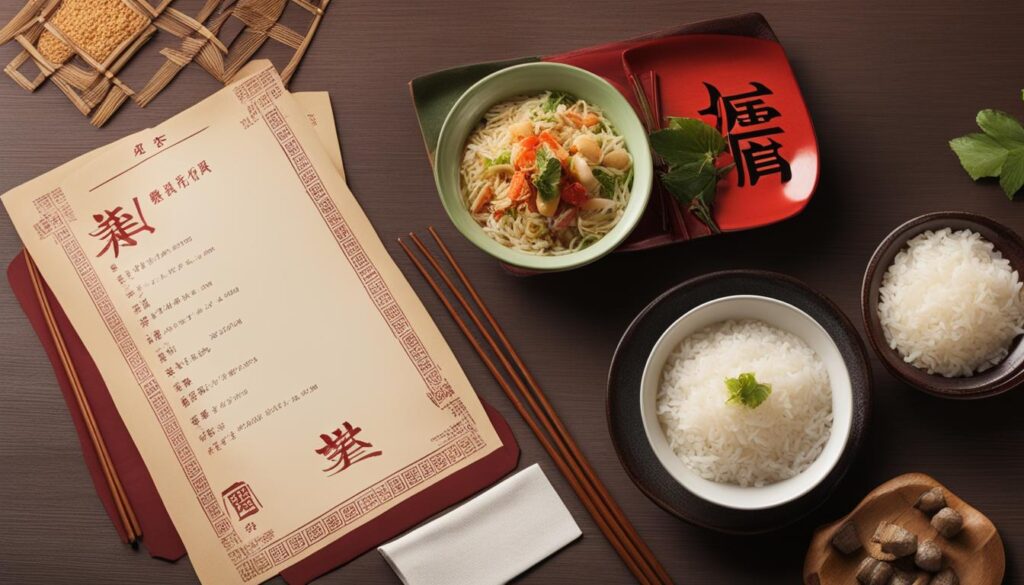
By learning these useful Chinese phrases for ordering food, you’ll be able to navigate menus and communicate with servers confidently. Bon appétit!
Basic Chinese Phrases for Asking Directions
Exploring a new city can be exciting, but it can also be overwhelming, especially if you don’t speak the language. Fear not, these basic Chinese phrases for asking directions will help you navigate with ease. Whether you’re looking for a specific landmark or trying to find your way back to your hotel, these phrases will help you communicate effectively.
When asking for directions, it’s important to be polite. Begin with a greeting such as:
Nǐ hǎo!
Qǐng wèn…
Which means “Hello, excuse me…” in English. Next, ask for directions using the following phrases:
| Phrase | Characters | Pronunciation |
|---|---|---|
| Where is…? | ……zài nǎlǐ? | …zi nali? |
| How do I get to…? | wǒ rúhé dào……? | wo ruhe dao…? |
| Turn left/right | zuǒ/biān tǎo | zuo/bian tao |
| Straight ahead | zhízhe zǒu | zhizhe zou |
| Close/Far | Jìn/Yuǎn | jin/yuan |
Finally, thank the person for their help with the phrase:
Xièxiè nǐ!
Which means “Thank you!” in English.
By using these basic Chinese phrases for asking directions, you’ll be able to confidently navigate your way around a new city. Don’t be afraid to practice and use them, locals will appreciate your effort to speak their language!

Interacting with Locals in Chinese
One of the most fulfilling aspects of travel is meeting and interacting with the locals. Not only does this give you insight into the country’s culture, but it also leads to unforgettable experiences and memories. In this section, we’ll provide you with essential Chinese phrases to connect with locals and enhance your travel experience.
If you’re meeting someone for the first time, use the phrase “Nǐ hǎo”, which means hello. After introducing yourself, ask their name by saying “Nǐ jiào shénme míngzì?” to which they will answer their name. If you need help with something, you can politely ask by saying “Qǐng wèn, nǐ néng bāng wǒ ma?” which means “Excuse me, could you help me, please?”
If you want to express gratitude, use the phrase “Xièxie”, which means thank you. You can also say “Hěn hǎo chī” to compliment the food, which means “this tastes very good.”
For initiating conversations, you can start by asking about their day by saying “Nǐ jīntiān zěnmeyàng?”, meaning “How is your day today?” and try to ask follow-up questions to keep the conversation going.
Here are some more useful phrases for interacting with locals:
| Chinese | English Translation |
|---|---|
| Nǐ shuō yīngyǔ ma? | Do you speak English? |
| Zài jiàn | Goodbye |
| Wǒ yào yīgè… | I want a… |
| Háishì píjiǔ yǒu guò yī huì’er | Could I have another beer? |
With these essential Chinese phrases, you’ll be able to connect with locals, learn more about the culture and create unforgettable memories. So, don’t be afraid to strike up a conversation and embrace the richness of the Chinese language!

Chinese Phrases for Shopping and Negotiating Prices
Shopping in China can be an exciting adventure, and knowing some useful Chinese phrases can help you navigate the markets, boutiques, and street vendors with confidence. When it comes to bargaining and negotiating prices, using the right words can make all the difference. Here are some essential phrases that will help you get the best bargains and enjoy a successful shopping experience.
Useful Chinese Phrases for Shopping
| English | Chinese Characters | Pronunciation |
|---|---|---|
| I want to buy… | 我想买… | Wǒ xiǎng mǎi… |
| How much is this? | 这个多少钱? | Zhège duōshao qián? |
| Too expensive! | 太贵了! | Tài guì le! |
| Can I get a discount? | 能打个折吗? | Néng dǎ gè zhé ma? |
| What is your best price? | 你们最低价是多少? | Nǐmen zuì dī jià shì duōshao? |
| Do you have a smaller size? | 有没有更小一号的尺码? | Yǒu méiyǒu gèng xiǎo yī hào de chǐmǎ? |
| Can I try it on? | 可以试穿吗? | Kěyǐ shì chuān ma? |
| This is not what I’m looking for. | 这不是我要找的。 | Zhè bùshì wǒ yào zhǎo de. |
| Thank you! | 谢谢! | Xièxiè! |
Note: When bargaining, it’s essential to be respectful and friendly. Try starting with a smile, greeting, and asking about the seller’s day before offering a price. Remember, it’s all about finding a balance, and both parties should feel happy with the outcome.
With these useful Chinese phrases, you’ll be able to bargain and negotiate like a pro, finding the best prices on all your favorite items. Don’t forget to use a friendly tone, be respectful, and have fun exploring the diverse shopping culture in China!
Cultural Etiquette and Polite Expressions
Travelling to China involves experiencing a beautiful cultural heritage, delicious food, and fantastic people. Nevertheless, to convey respect and appreciation, it’s crucial to understand Chinese cultural etiquette and display good manners. By utilizing Chinese travel phrases and polite expressions, you can establish good relationships and have an enjoyable stay.
| Polite Expressions | Chinese Travel Phrases |
|---|---|
| Ni hao. | Hello. |
| Zai jian. | Goodbye. |
| Xie xie. | Thank you. |
| Bu keqi. | You’re welcome. |
Gestures and Taboos
Knowing the correct body language to use in China is important, as it can convey different meanings in different cultures. For instance:
- Do not point with your finger; it’s rude.
- Do not touch or pat anyone on the head, especially children, as it’s considered disrespectful.
- Bowing and nodding are great ways to show respect in Chinese culture.
Gift Giving and Receiving
Gift giving and receiving is customary in China, but you need to be extra careful while choosing gifts:
- Don’t buy a clock as a gift, as it symbolizes death in Chinese culture.
- Don’t give anyone a white or black object, as it’s associated with mourning in China.
- Red is the color of good luck and is a great color for gifts.
- Wrap your gifts in red, gold, or yellow wrapping paper.
“By learning and respecting cultural etiquette, you’ll undoubtedly build long-lasting connections with the locals and create unforgettable memories- isn’t that what travelling is all about?” – Anonymous
Learning Resources for Mastering Chinese Phrases
Learning basic Chinese phrases for travel can seem intimidating, but don’t worry! There are plenty of resources available to help you master the basics and enhance your travel experience in China.
Language Learning Apps
Language learning apps like Duolingo and Babbel are great tools for practicing basic Chinese phrases for travel. These apps offer interactive lessons, quizzes, and conversation simulations to help you build your language skills on-the-go.
Online Resources
Online resources such as FluentU and ChineseClass101 provide comprehensive language lessons and tailored courses to fit your travel needs. You can learn basic Chinese phrases for travel, cultural etiquette, and even stroke order for Chinese characters!
Phrasebooks
Phrasebooks like “Lonely Planet Mandarin Phrasebook” and “Rick Steves’ Mandarin Phrase Book & Dictionary” are fantastic resources to carry with you while traveling. These compact, pocket-sized books provide essential Chinese phrases and translations for various travel scenarios.
| Resource | Features |
|---|---|
| Duolingo | – Interactive lessons and quizzes – Conversation simulations – Free |
| Babbel | – Tailored language courses – Enhanced speech recognition software – Subscription-based |
| FluentU | – Interactive and immersive language lessons – Learn basic Chinese phrases for travel – Cultural and historical context |
| ChineseClass101 | – Audio and video lessons – Comprehensive curriculum – Live 24/7 support |
| “Lonely Planet Mandarin Phrasebook” | – Essential Chinese phrases – Clear phonetic pronunciation – Lightweight and pocket-sized |
| “Rick Steves’ Mandarin Phrase Book & Dictionary” | – Practical phrases and vocabulary – Cultural information – Detailed pronunciation guide |
With these resources, you’ll be well on your way to mastering basic Chinese phrases for travel and immersing yourself in the rich culture of China!
Conclusion
Learning basic Chinese phrases for your travels is a valuable investment of your time and effort. By mastering essential phrases, you’ll be able to navigate China with confidence, connect with locals, and create unforgettable memories.
Remember to keep practicing and using the phrases you’ve learned, even if you make mistakes. Your effort will be appreciated and will go a long way in breaking down language barriers.
With plenty of resources available, including language learning apps, phrasebooks, and classes, mastering Chinese phrases has never been easier. Start your language journey today and embrace the richness of the Chinese language.
Thank you for reading, and we wish you a successful and enjoyable travel experience in China. Don’t forget to use all the Chinese travel phrases you’ve learned!





